Alberto La Marmora Commemorative Plaque
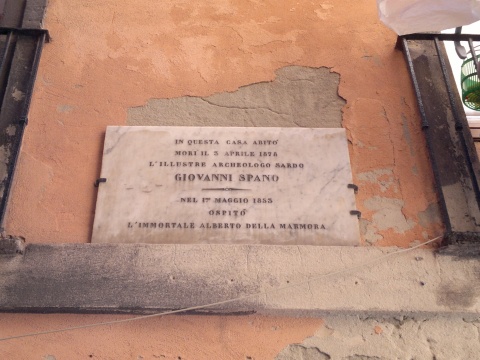
Immagine per l'APP
Lapide Commemorativa di Alberto La Marmora
Categoria/Sottocategoria
macrocategoria
Descrizione

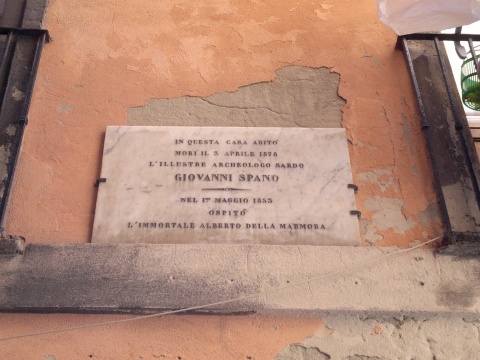
In 65, Nicolò Canelles street there is a plaque in memory of the Italian general and scientist Alberto La Marmora, who lived for a long time in Sardinia. A street in the Castello district is also dedicated to him.

Alberto Ferrero della Marmora (or Alberto della Marmora or Alberto La Marmora) born in Turin, was an Italian general, naturalist, cartographer and politician. He was the brother of three other important generals of the Kingdom of Sardinia and then of the Kingdom of Italy.

He made his first trip to Sardinia in 1819 and arrived in Cagliari after a 12-day crossing. He wanted to apply to the studies of ornithology and practice hunting. He was with prof. Keyser, a geologist from Cristiania, (today's Oslo) and the knight De Prunner, director of the Museum of natural history and antiquities in Cagliari. This first trip provided him with ample material, which he will use in his subsequent writings on Sardinia, to describe the island in all its parts. He spent most of his life back and forth between Turin and Sardinia; in 1836 he was also appointed Inspector of mines in Sardinia and, in 1841, he was entrusted with the command of the Navy School of Genoa. In 1834 was also knight of the Order of Saints Maurizio and Lazzaro.

In the Senate he always fought for the interests of the island and on 16 November 1851 he was granted Cagliari citizenship. To Sardinia he dedicated his studies in French on economic and physical matters: "Voyage en Sardaigne", published in Paris in 1826. Embellished with 19 illustrated tables by Giuseppe Cominotti and others, he expanded the studies previously conducted by Francesco Cetti, probably remaining the most famous work among the travel reports of the nineteenth century.

The text contains his observations, statistics, research on the nature and archaeological heritage of the region. The second edition of the work was even more organic as it was divided into three branches with expanded treatments. The work is divided into: "Physical and human geography of Sardinia", published in 1839; "Antiquity", published in 1840 and "Geology", published in 1857 in two volumes. The first volume begins with a compendium of ancient and modern Sardinian history, to then describe the island from a physical and climatic point of view and subsequently examines the mineral, vegetable and animal kingdom, the talk of the inhabitants, whose physical characteristics are also analysed, customs, habits and language and it concludes with a picture on the administration and economic activities of Sardinia. The second volume deals with the island's pre-Roman monuments, similar to the menhirs, and with some ancient inscriptions, with the nuraghes. Then he tries to reconstruct the geography of the island at the time of the Romans and tries to recreate the ancient road network, drawing much news from the research of other scholars, then he goes on to examine the Roman antiquities present on the island, deepening on the ancient Sardinian medals, on tombs, sarcophagi, temples, amphitheatres and theatres, and collects inscriptions from Roman temples. The third and final part of the work describes the island from a geological point of view, examining the various types of terrain and fossils from different eras and to do this La Marmora sought valuable collaborations especially for the examination of fossils and rocks becoming, of fact, a pioneer of Sardinian geology, of which he traced the basic lines. The exhibition is interspersed with anecdotes about the costumes of the inhabitants and the adventures that happened to him in his travels.

From 1851 to 1857 he made several trips to Sardinia to finish his studies.

Overall, the Count dedicated more than fifty scientific publications to Sardinia which, although they did not spread widely on the island, did so abroad, focusing attention on a land hitherto shrouded in darkness, giving it value and attracting other curious glances.

He travelled with his equipment for the districts taking notes and making topographical measurements. He was responsible for measuring the highest point of the Gennargentu, which has his name (Punta La Marmora - 1,834 meters).

In 1884 the first geographic map of Sardinia was republished in photolithographic reproduction with the title Atlas of the island of Sardinia in scale 1: 50000, made with scientific criteria, as a result of decades of work started from the nautical chart of Captain William Henry Smyth, of which Della Marmora served himself, in collaboration with the specialist Carlo De Candia, also a general.

As a scientist, he studied the seabed and the coasts close to the rivers. His studies and observations were used in the feasibility analysis of the Suez Canal. His considerations will then be taken up again by Luigi Negrelli and Pietro Paleocapa, who will have a primary role in the construction of the Canal.

Passionate archaeology investigator, in 1829 he entered the Academy of Sciences of Turin, of which he later became vice-president, and, in 1832, in the Geological Academy of Florence. He also became a member of several prestigious institutes of studies such as the Lombard Institute of Sciences and Letters in Milan, the Agricultural and Economic Society of Cagliari and the Royal Society of Naples, and a member of the Deputation of Homeland History of Turin. He obtained the diploma of the Geological Societies of France, Berlin and London and he was officially commemorated by prestigious institutions such as the Royal Geographical Society of London.

Indirizzo
Via Nicolò Canelles, 65
Poligono GEO

Lapide Commemorativa di Alberto La Marmora

Lapide Commemorativa di Alberto La Marmora

Via Nicolò Canelles, 65
Fascia età
Fuori Cagliari
No
Quartiere
usato per affollamento
No
da usare solo per eventi e percorsi
Off
peso
Comune
Immagine per il Portale
Lapide Commemorativa di Alberto La Marmora

Add new review

Your review will be visible after approval by the editors

To post a review you must be an authenticated user.
Log in with Social Login
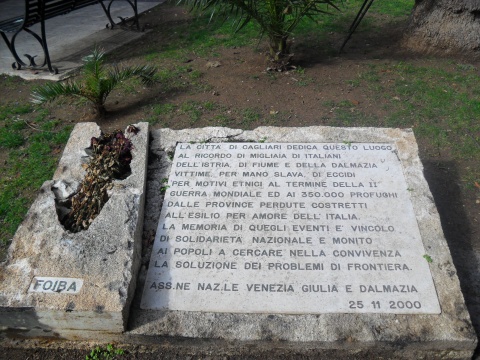
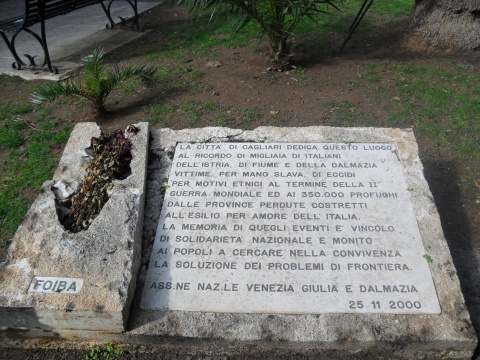
Foibe Victims Commemorative Plaque

Immagine per l'APP
Lapide Commemorativa delle Vittime delle Foibe
Categoria/Sottocategoria
macrocategoria
Descrizione

In Italy, since 2004, on 10 February (anniversary of the 1947 Paris Peace Treaty which sanctioned the passage to Yugoslavia of the former Italian provinces of the Adriatic), Remembrance Day has been celebrated, in homage to the martyrs of the sinkholes.

Between 1943 and 1945, over 10.000 women, men, old people and children were barbarously killed and thrown, often alive, into the cavities of the karst plateau, called foibas, victims of a planned ethnic cleansing that aspired to the extermination of the Italian presence in those lands, by the Slav communist troops of Titus. They were simple citizens with the only fault of being Italian. Often tortured, beaten and raped, then tied to each other with wire, then the first was pushed into the foiba, dragging all the others. Among the victims there also were 140 Sardinians, some of them Sulcis miners, transferred from Carbonia to the wells in Istria, but also some soldiers, especially financiers and carabinieri, serving in the eastern border.

Cagliari dedicated a park to them, called indeed, "Martyrs of the Foibe" Park which is located in Saint Lucifero street, and it contains the commemorative plaque.

Indirizzo
Via San Lucifero - Piazza Martiri delle Foibe
Poligono GEO

Lapide Commemorativa delle Vittime delle Foibe

Lapide Commemorativa delle Vittime delle Foibe

Via San Lucifero - Piazza Martiri delle Foibe

Fascia età
Fuori Cagliari
No
Quartiere
usato per affollamento
No
da usare solo per eventi e percorsi
Off
peso
Comune
Immagine per il Portale
Lapide Commemorativa delle Vittime delle Foibe

Add new review

Your review will be visible after approval by the editors

To post a review you must be an authenticated user.
Log in with Social Login
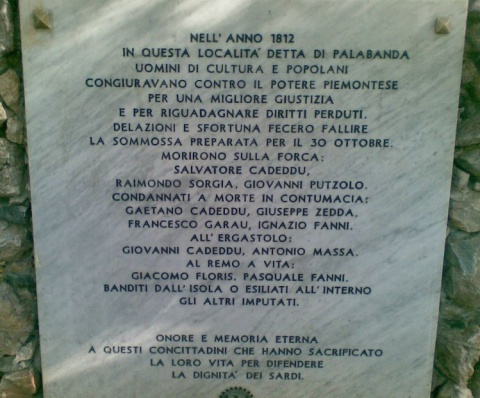
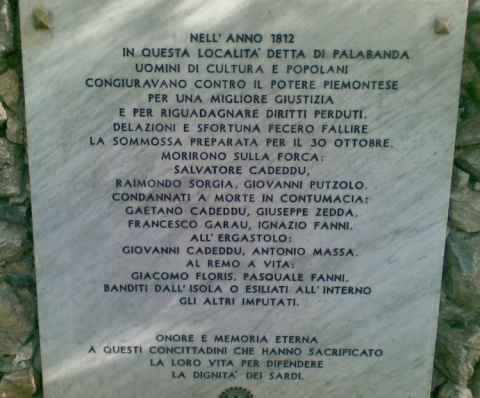
Palabanda Plot Commemorative Plaque

Immagine per l'APP
Lapide Commemorativa della Congiura di Palabanda
Categoria/Sottocategoria
macrocategoria
Descrizione

In 1812, Sardinia was hit by a long period of drought which destroyed the crops and caused a serious famine coinciding with a smallpox epidemic; thousands of people died of hunger and disease.

Cagliari was reigned by Vittorio Emanuele I, residing there with his retinue and new taxes were imposed on the Sardinian people to cover the costs of the forced stay of the Savoy court.

In this already tragic situation, with the lords who became increasingly wealthy thanks to the sale of hoarded products and the public officials who used their powers to enrich their assets, the revolt immediately took root in the desperate people.

The conspirators met in Stampace, on a farm owned by the lawyer Salvatore Cadeddu, secretary of the University, located in the town of Palabanda, in the area where the Botanical Garden stands today. There were both middle-class citizens but also commoners and their intent was only to drive out public officials and courtiers who were bringing Sardinia to a catastrophe, it was not a revolt against the sovereign and the monarchy.

The insurrection was set for October 30, 1812 and it involved the assault on the barracks of the Royal Navy, to enter the Castle occupying the most strategic places, arresting the commander of the city, Giacomo Pes of Villamarina, and expelling the courtiers and public officials protecting the king and his family.

But the news came to the tax lawyer Raimondo Garau who informed the king and the Colonel Villamarina, who ordered an intense vigilance.

On the day set for the revolt, while numerous patrols of soldiers controlled the city, some conspirators and the baker Floris were sent to call others on hold, but they came across a patrol of Piedmontese and, frightened, they came back warning the colleagues who for the most part gave up the endeavour.

Meanwhile, the conspirators in the Marina district, not seeing the Stampacini, doubtful and fearful, sent Giovanni Putzolu with some companions to understand what was going on, but they met Colonel Villamarina, who came down from Castello to watch in person and Putzolu, panicked, aimed a pistol at the commander but his friends themselves prevented him from shooting.

Putzolu and Sorgia were immediately arrested and, on 13 May 1813, after a rapid trial, hanged. Cadeddu, Fanni, Zedda and Garau judged in absentia, suffered the same sentence; to Floris was imposed life imprisonment; Salvatore Cadeddu, captured in the Iglesiente area, was hanged on 2 September.

In the central square of the Botanical Garden there is a monument in memory of the conspirators of Palabanda as liberators of Sardinia and for having been punished too severely.

Indirizzo
Via Sant'Ignazio da Laconi - Orto Botanico (piazzetta centrale)
Poligono GEO

Lapide Commemorativa della Congiura di Palabanda

Lapide Commemorativa della Congiura di Palabanda

Via Sant'Ignazio da Laconi - Orto Botanico (piazzetta centrale)

Fascia età
Fuori Cagliari
No
Quartiere
usato per affollamento
No
da usare solo per eventi e percorsi
Off
peso
Comune
Immagine per il Portale
Lapide Commemorativa della Congiura di Palabanda

Add new review

Your review will be visible after approval by the editors

To post a review you must be an authenticated user.
Log in with Social Login
Anti-Malaria Campaign Commemorative Plaque

Immagine per l'APP
Lapide Commemorativa della Campagna Antimalarica
Categoria/Sottocategoria
macrocategoria
Descrizione

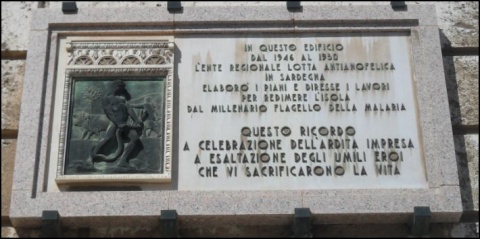
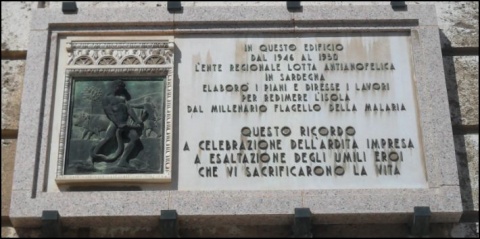
At the beginning of the 1900s malaria was killing about two thousand people per year in Sardinia, so between 1948 and 1950 the "Sardinian Project" took place, the great campaign against the causes of the endemic plague of malaria conducted by ERLAAS (Ente regionale della lotta antianofelica = Regional Institution for the anti-anophelic fight) and funded among others by the Rockefeller Foundation (supervision and scientific direction), UNRRA (United Nations Relief and Rehabilitation Administration) and ECA (Economic Cooperation Administration). The project was carried out in two phases: in the first the objective was to destroy adult mosquitoes and all houses, public buildings, schools, farmhouses and barns, bridges, monuments, nuraghi, domus de janas, mining wells and quarries, military installations and caves were reclaimed with DDT.

In the second phase, thousands of workers and technicians were employed in the search for the larvae of Anopheles Labranchiae, which, with planes and teams of ground exterminators, sprayed streams and marshes and built reclamation channels. The ERLAAS army was made up of 32,000 men, 200 vehicles and 4 planes.

At the "Alberto Riva Villasanta" Educational Institution, in Garibaldi Square, there still is a monument in memory of the work and sacrifice of these people.

Indirizzo
Piazza Garibaldi c/o Ist. Scolastico "Alberto Riva Villasanta"
Poligono GEO

Lapide Commemorativa della Campagna Antimalarica

Lapide Commemorativa della Campagna Antimalarica

Piazza Garibaldi c/o Ist. Scolastico "Alberto Riva Villasanta"

Fascia età
Fuori Cagliari
No
Quartiere
usato per affollamento
No
da usare solo per eventi e percorsi
Off
peso
Comune
Immagine per il Portale
Lapide Commemorativa della Campagna Antimalarica

Add new review

Your review will be visible after approval by the editors

To post a review you must be an authenticated user.
Log in with Social Login
Camarassa Murder Commemorative Plaque

Immagine per l'APP
Lapide Commemorativa dell'Omicidio Camarassa
Categoria/Sottocategoria
macrocategoria
Descrizione

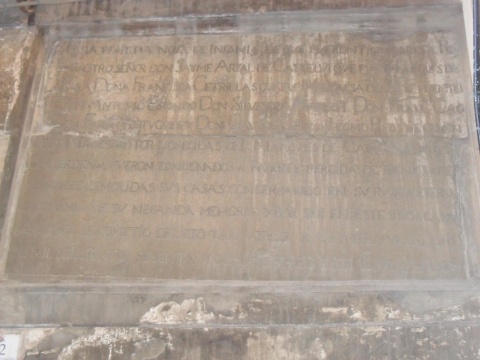
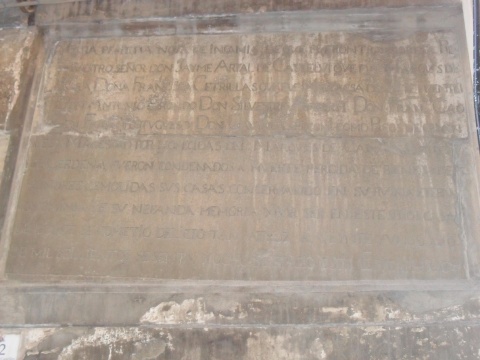
Plaque commemorating the murder of the Spanish viceroy Don Emanuele Gomez de los Cobos, Marquis of Camarassa, killed by members of Sardinian nobility in 1668.

The Spanish Marquis of Camarassa was the Viceroy assassinated following a conspiracy by a group of Sardinian nobles against the Spanish domination in Sardinia in 1660.

In particular, the Marquis and his servant were tortured with the wheel technique (a medieval torture practice in which the condemned man was tied on a wooden wheel in front of the public that could observe while the executioner fractured the bones of the victim). Then their heads were cut off and displayed on the towers of Saint Pancrazio and of the Elephant as a warning, their assets were confiscated and their fields sprinkled with salt.

In the house from which the rifle shots started, in 32, Canelles street in Cagliari, the monument that the Spaniards erected as a memory of the conspiracy is walled. The inscription is in Spanish and in capital characters with adjoining embellishments and italic strokes.

Indirizzo
Via Canelles, 42
Poligono GEO

Lapide Commemorativa dell'omicidio Camarassa

Lapide Commemorativa dell'omicidio Camarassa

Via Canelles, 42

Fascia età
Fuori Cagliari
No
Quartiere
usato per affollamento
No
da usare solo per eventi e percorsi
Off
peso
Comune
Immagine per il Portale
Lapide Commemorativa dell'Omicidio Camarassa

Add new review

Your review will be visible after approval by the editors

To post a review you must be an authenticated user.
Log in with Social Login
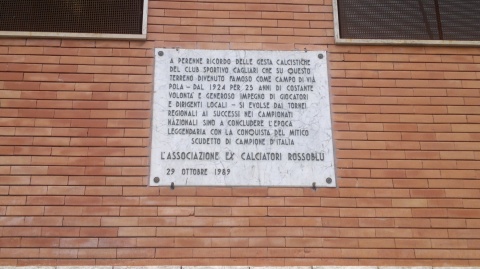
Via Pola Field Commemorative Plaque

Immagine per l'APP
Lapide Commemorativa del Campo di Via Pola
Categoria/Sottocategoria
macrocategoria
Descrizione

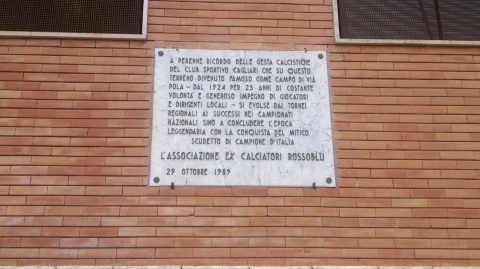
Plaque commemorating Cagliari Football Club's beginnings and the field where it would play from 1924 to 1949. Later the Cagliari side went on to play in Serie A, eventually winning the Scudetto in 1970.

The inscription on the plaque reads:


A PERENNIAL REMEMBER OF THE FOOTBALL GESTURE OF THE CAGLIARI SPORTS CLUB THAT ON THIS LAND BECOME FAMOUS AS A FIELD OF POLA STREET

SINCE 1924 FOR 25 YEARS OF CONSTANT WILL AND GENEROUS COMMITMENT TO PLAYERS AND LOCAL LEADERS

EVOLVED FROM TOURNAMENTS REGIONAL TO THE NATIONALS CHAMPIONSHIP SUCCESSES

UNTIL CONCLUDING THE LEGENDARY PERIOD WITH THE CONQUEST OF THE MYTHICAL ITALIAN CHAMPION SHIELD

THE EX ROSSOBLU FOOTBALL ASSOCIATION

Indirizzo
Via Pola
Poligono GEO

Lapide Commemorativa del Campo di Via Pola

Lapide Commemorativa del Campo di Via Pola

Via Pola

Fascia età
Fuori Cagliari
No
Quartiere
usato per affollamento
No
da usare solo per eventi e percorsi
Off
peso
Comune
Immagine per il Portale
Lapide Commemorativa del Campo di Via Pola

Add new review

Your review will be visible after approval by the editors

To post a review you must be an authenticated user.
Log in with Social Login
Martini's brothers Commemorative Plaque

Immagine per l'APP
Lapide Commemorativa dei Fratelli Martini
Categoria/Sottocategoria
macrocategoria
Descrizione

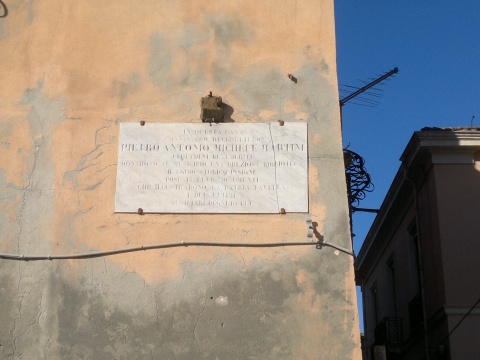
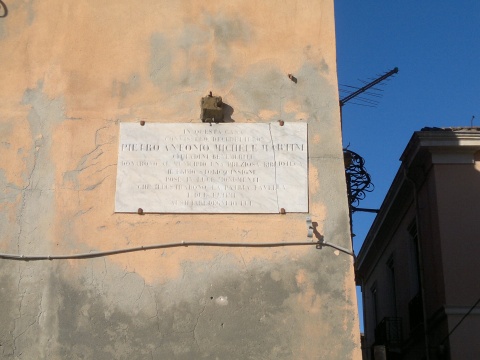
The municipality of Cagliari dedicated the street in which he was born to Pietro Martini, an important historian, in the Castello district and affixed a plaque dedicated to him and his brothers' memory.

Martini was Secretary of State of Sardinia, deputy, director of the Cagliari University Library and a history researcher continuing the work of Giuseppe Manno. He is the author of the "Sardinian Biography", "Ecclesiastical History of Sardinia", "History of Sardinia from 1799 to 1816" and "Compendium of the history of Sardinia" and at his death, in 1866, he left all his books to the Municipality which started and formed the civic library of Cagliari.

Together with the brothers Antonio, a lawyer, and Michele, employed in the Royal Archives, Pietro Martini was the animator and most assiduous editor of the "Sardinian Indicator", a periodical of strict monarchist-absolutist observance.

Indirizzo
Via Pietro Martini, 16
Poligono GEO

Lapide Commemorativa dei Fratelli Martini

Lapide Commemorativa dei Fratelli Martini

Via Pietro Martini, 16

Fascia età
Fuori Cagliari
No
Quartiere
usato per affollamento
No
da usare solo per eventi e percorsi
Off
peso
Comune
Immagine per il Portale
Lapide Commemorativa dei Fratelli Martini

Add new review

Your review will be visible after approval by the editors

To post a review you must be an authenticated user.
Log in with Social Login
Railwaymen Commemorative Plaque

Immagine per l'APP
Lapide Commemorativa dei Ferrovieri Caduti
Categoria/Sottocategoria
macrocategoria
Descrizione

In 1943, with Italy still at war alongside Nazi Germany, Sardinia and Cagliari became an important strategic target for the Allied air force.

Due to the very serious material and especially human losses endured, on 12 May 1950 the President of the Republic Luigi Einaudi awarded the city the gold medal for military value.

Even today, by watching the few films of that time, the scenario of death and devastation caused by the bombing of familiar and dear places appears unreal.

At 12:55 on Sunday 28 February, the third and bloodiest raid on Cagliari began. In about two hours, 85 planes dropped 538 bombs for 123 tons of explosives. The Palace of the Customs and the Railways of the State station were destroyed, much of the Roma Street fell into disrepair. Already unusable due to the lack of electricity, the sirens did not sound the alarm and many people were surprised away from the shelters: according to official figures, 200 citizens lost their lives, a few hundred others were injured.

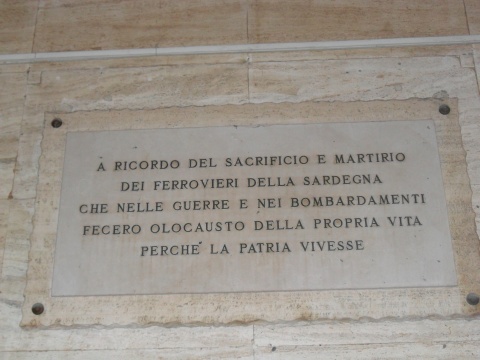
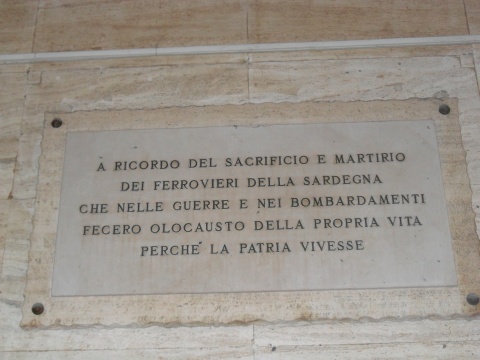
Inside the railway station of Cagliari there is the commemorative plaque for deceased workers. The commemorative epigraph of the victims reads:


IN MEMORY OF THE SACRIFICE AND MARTYRDOM

OF RAILWAYS OF SARDINIA

THAT IN WARS AND BOMBARDS

MADE AN HOLOCAUST OF THEIR LIVES

SO THAT THE HOMELAND LIVED

Indirizzo
Via Sassari, 7/A - Interno Stazione Ferroviaria
Poligono GEO

Lapide Commemorativa dei Ferrovieri Caduti

Lapide Commemorativa dei Ferrovieri Caduti

Via Sassari, 7/A - Interno Stazione Ferroviaria

Fascia età
Fuori Cagliari
No
Quartiere
usato per affollamento
No
da usare solo per eventi e percorsi
Off
peso
Comune
Immagine per il Portale
Lapide Commemorativa dei Ferrovieri Caduti

Add new review

Your review will be visible after approval by the editors

To post a review you must be an authenticated user.
Log in with Social Login
Air Raid Victims Commemorative Plaque (2)

Immagine per l'APP
Lapide Commemorativa 28 febbraio 1943
Categoria/Sottocategoria
macrocategoria
Descrizione

In 1943, with Italy still at war alongside Nazi Germany, Sardinia and Cagliari became an important strategic target for the Allied air force.

Due to the very serious material and especially human losses endured, on 12 May 1950 the President of the Republic Luigi Einaudi awarded the city the gold medal for military value.

Even today, by watching the few films of that time, the scenario of death and devastation caused by the bombing of familiar and dear places appears unreal.

At 12:55 on Sunday 28 February, the third and bloodiest raid on Cagliari began. In about two hours, 85 planes dropped 538 bombs for 123 tons of explosives. The Palace of the Customs and the Railways of the State station were destroyed, much of the Roma Street fell into disrepair. Already unusable due to the lack of electricity, the sirens did not sound the alarm and many people were surprised away from the shelters: according to official figures, 200 citizens lost their lives, a few hundred others were injured.

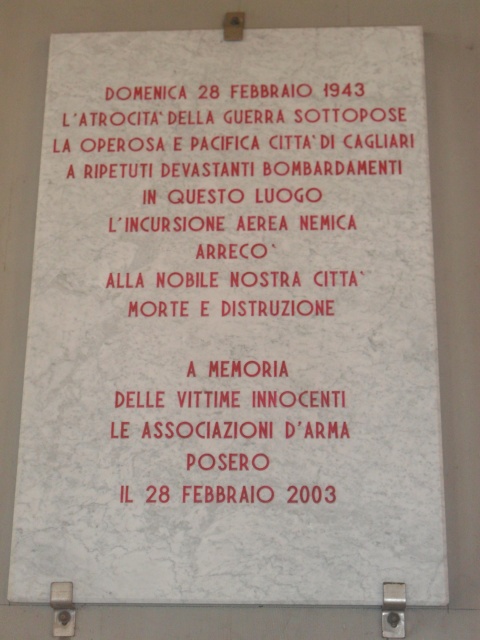
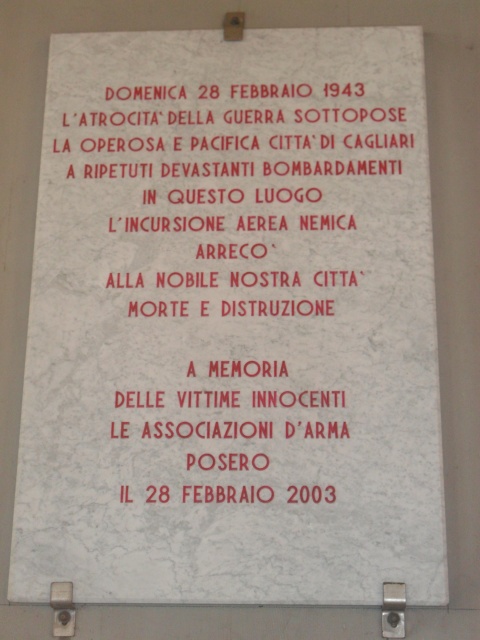
The commemorative epigraph of the victims, placed by the associations of arms in 2003 reads:

SUNDAY FEBRUARY 28, 1943

THE ATROCITY OF THE WAR SUBJECTED THE WORKING AND PEACEFUL CITY OF CAGLIARI TO REPEATED DEVASTANT BOMBARDMENTS IN THIS PLACE THE ENEMY AIRCRAFT CAUSED TO OUR NOBLE CITY DEATH AND DESTRUCTION

IN MEMORY OF THE INNOCENT VICTIMS

Indirizzo
Via Roma angolo Via Lepanto
Poligono GEO

Lapide Commemorativa 28 febbraio 1943

Lapide Commemorativa 28 febbraio 1943

Via Roma angolo Via Lepanto

Fascia età
Fuori Cagliari
No
Quartiere
usato per affollamento
No
da usare solo per eventi e percorsi
Off
peso
Comune
Immagine per il Portale
Lapide Commemorativa 28 febbraio 1943

Add new review

Your review will be visible after approval by the editors

To post a review you must be an authenticated user.
Log in with Social Login
Air Raid Victims Commemorative Plaque (1)

Immagine per l'APP
Lapide Commemorativa 17 Febbraio 1943
Categoria/Sottocategoria
macrocategoria
Descrizione

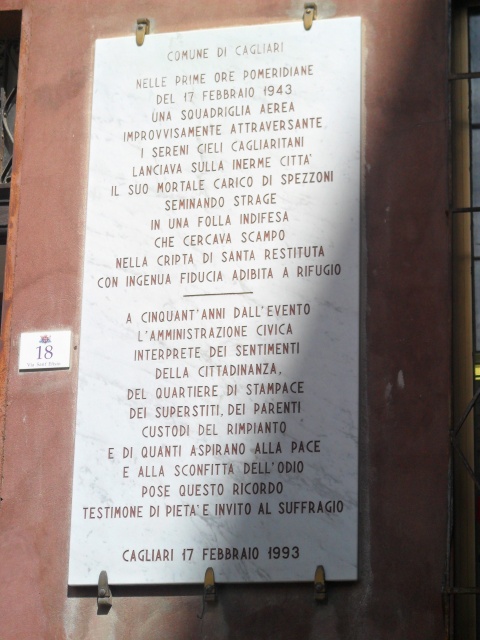
In 1943, Italy was still in war on the side of Nazi Germany. Sardinia and Cagliari became an important strategic objective for the Allied Air Force. For the serious material, and above all, human losses, on May 12th 1950 the President of the Italian Republic Luigi Einaudi gave to the city the gold medal for military valour. Even today, as we can see from the few period films, the scenery of death and devastation caused by the bombings, in places familiar and dear to us, seems unreal.

On Wednesday 17th February 1943, Cagliari suffered the first dramatic raid. In the afternoon, American bombers flew over the city centre, dropping a large number of bombs.

According to the official bulletin 100 people died , 255 others were injured. That day, there was a cruel massacre of unarmed fellow citizens, who had hoped to find a safe shelter in Sant'Efisio's street, between the churches of St. Anne and St. Restituta.

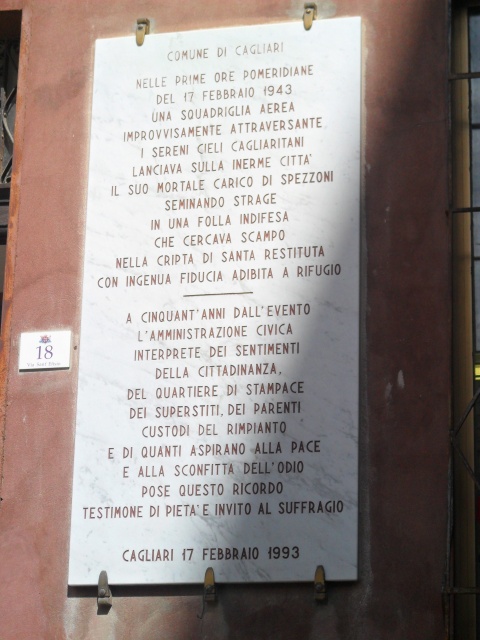
Here below, the inscription commemorating the victims, placed by the civic administration in occasion of the fiftieth anniversary of the massacre:

IN THE EARLY AFTERNOON HOURS ON FEBRUARY 17TH 1943

AN AIR SQUADRON SUDDENLY CROSSING THE SAFE HEAVENS OF CAGLIARI THREW ON THE DEFENSELESS CITY ITS LOAD OF DEATH SPLINTERS SOWING MASSACRE IN AN HELPLESS CROWD  WHO TRIED TO ESCAPE TO THE CRYPT OF SANTA RESTITUTA USED AS A SHELTER WITH A NAIVE TRUST

FIFTY YEARS AFTER THE EVENT THE CIVIC ADMINISTRATION INTERPRETING THE FEELINGS OF STAMPACE DISTRICT'S INHABITANTS OF THE SURVIVORS OF THE RELATIVES, GUARDIAN OF REGRET AND OF THOSE WHO ASPIRE TO PEACE AND HATRED DEFEAT PLACED THIS MEMORY AS A WITNESS OF COMPASSION AND AN INVITATION TO SUFFRAGE.

Indirizzo
Via Sant'Efisio, 18
Poligono GEO

Lapide Commemorativa 17 Febbraio 1943

Lapide Commemorativa 17 Febbraio 1943

Via Sant'Efisio, 18

Fascia età
Fuori Cagliari
No
Quartiere
usato per affollamento
No
da usare solo per eventi e percorsi
Off
peso
Comune
Immagine per il Portale
Lapide Commemorativa 17 Febbraio 1943

Add new review

Your review will be visible after approval by the editors

To post a review you must be an authenticated user.
Log in with Social Login