Consulate of Finland
Consolato di Finlandia
Via Roma, 173
Add new review
Your review will be visible after approval by the editors
To post a review you must be an authenticated user.
Log in with Social Login

Consolato di Finlandia
Via Roma, 173
Your review will be visible after approval by the editors
To post a review you must be an authenticated user.
Log in with Social Login

Consolato di Estonia
Via Niccolò Machiavelli, 81
Your review will be visible after approval by the editors
To post a review you must be an authenticated user.
Log in with Social Login

Consolato di Danimarca
Via Roma, 121
Your review will be visible after approval by the editors
To post a review you must be an authenticated user.
Log in with Social Login

Consolato di Bielorussia
via Lanusei, 29
Your review will be visible after approval by the editors
To post a review you must be an authenticated user.
Log in with Social Login

Consolato del Principato di Monaco
Via Parigi, 37
Your review will be visible after approval by the editors
To post a review you must be an authenticated user.
Log in with Social Login

Consolato del Belgio
Via Alghero, 35
Your review will be visible after approval by the editors
To post a review you must be an authenticated user.
Log in with Social Login

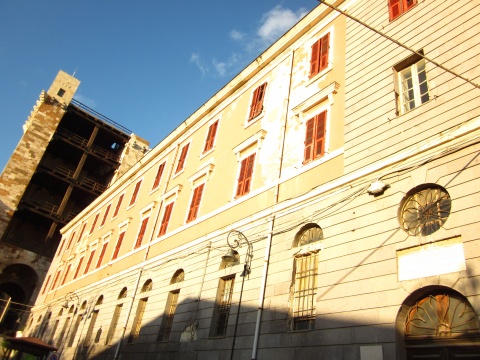
The Conservatory of the Daughters of Providence dates back to 1831. Former college for nobles, in the 19th century it became home to a charitable institution for orphans. Its wide Neoclassical facade dominates the east side of Piazza Indipendenza.
The Conservatory was originally located in a house in Via San Giuseppe (Castello district) and was supported by city charity and state aids. The institute was born on the initiative of Father Gian Battista Vassallo of the “Compagnia di Gesù” (Jesus Company), in order to accommodate poor girls, educating them in a Christian way and teaching them the necessary works to become good mothers.
In 1822 the Viceroy Count D'Agliano introduced several reforms, that aimed at improving the institution and he appointed the priest Lorenzo Frassetto da Nulvi as administrator. A weaving factory was set up and the boarders were trained in this work. The growth of the institution made it necessary to find a new area. The government gave to the Conservatory the old building of the College of Nobles, located in Piazza Indipendenza. It was rebuilt and adapted to the new requirements by the engineer E. Marchesi and it was occupied from 1831.
Sister Giuseppina Nicoli (now beatified) taught here from 1885 to 1889. The girls' school was open until the end of the 90s.
Nowadays the building is closed.
Conservatorio delle Figlie della Provvidenza
Piazza Indipendenza
Your review will be visible after approval by the editors
To post a review you must be an authenticated user.
Log in with Social Login
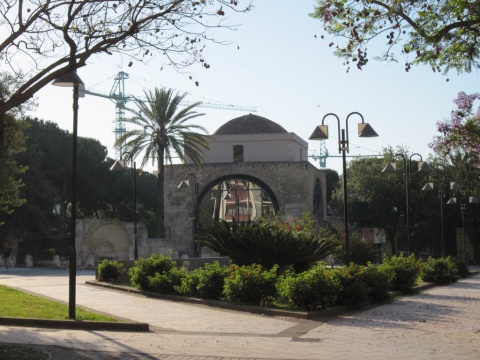
The archaeological complex of Saint Saturno is characterized by the presence of a church and a funeral area around it, which can be accessed from the current Piazza San Cosimo. The burial area is located in the northern side with respect to the church, and houses part of the necropolis including mausolea, sarcophagi, tumuli (grave mound) and tile-built tombs.
The area was used as a necropolis since the late Republican Age. Subsequently, it was conspicuously exploited with the same purpose by the local christian community, although the archaeological and epigraphic evidences of that use cannot testify a continuity throughout the ancient times.
The remains found at the adjacent church of Saint Lucifero bear witness of a burial use, whose link to the preexisting structures in the area of Saint Saturno and to the well of Saint Cosimo is still unknown.
The burial purpose, with respect to the different uses of those areas, reveals the complex problem of their distribution and dating: in fact, some recent excavations in the area opposite the Basilica of Saint Saturnino, currently housing a newly constructed square, have brought to light a quadrangular well that lets assume a sacred function within the hypogeal worship of water.
Complesso Paleocristiano di San Saturno
Via San Lucifero - Piazza S. Cosimo
Your review will be visible after approval by the editors
To post a review you must be an authenticated user.
Log in with Social Login
The Column of Bonaria, located on the large staircase that precedes the Basilica, is surmounted by the Virgin and Child. It was positioned in the place where the miraculous chest containing the statue of the Virgin was found by the monks. According to legend, on March 25, 1370, a ship that left Catalonia was hit by a storm. The sailors decided to throw the cargo overboard including a heavy crate. As soon as the latter was launched into the waves, the storm subsided and the crate eventually landed in Cagliari, under the Bonaria hill.
Colonna di Bonaria
Viale Diaz presso Scalinata
Your review will be visible after approval by the editors
To post a review you must be an authenticated user.
Log in with Social Login
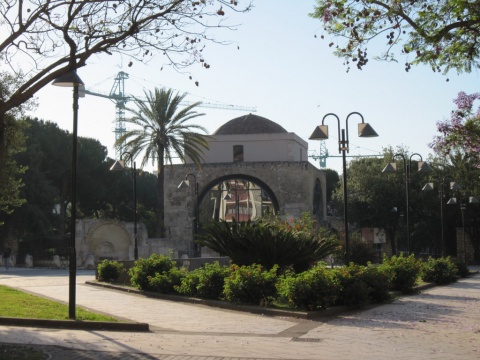
The collection features paintings and sculptures by some of the most representative Italian artists of the 20th century. All items were collected by the art collector and benefactor Francesco Paolo Ingrao.
250 works (including 40 sculptures) are collected in the 15 rooms on the two floors of the Gallery, representative of the Italian artistic movements, especially the Romans, which followed each other from the second half of the 19th century to the end of the 20th century. The exhibition itinerary follows a chronological order, starting from the ground floor with the nineteenth century by Angelo Inganni, Gioacchino Toma, Enrico Reycend and Ercole Rosa.
The early twentieth century are represented by the exponents of Divisionism Francesco Gioli, Leonardo Bistolfi, Armando Spadini, Arturo Noci and Camillo Innocenti. Among the most prestigious pieces is the Giacomo Balla’s painting depicting the sculptor Giovanni Prini, also present in the collection. Room IV contains 31 works that reflect the various stages of Umberto Boccioni's artistic career, the greatest exponent of the Italian futurist movement.
Continuing the journey through the rooms on the first floor, we move on to the twenties and thirties of Carlo Socrate and Emanuele Cavalli, of the sculptors Alfredo Biagini and Antonietta Raphael and of the neo-realism by Ardengo Soffici.
Among the works preferred by Ingrao stand out The Sailor by Filippo De Pisis and the three Still Life by Giorgio Morandi, whose numerous works enrich the collection of various oil paintings, an etching, nine drawings in ink or pencil and 241 letters.
There also are numerous works by the artists of the thirties and forties: Carlo Carrà, Fortunato Depero, Tullio Crali, Gino Severini, Fillia, Atanasio Soldati, Massimo Campigli, Adolfo Wildt, Francesco Messina, Antonio Donghi, Mario Mafai, Pio Someghini, Felice Casorati.
The final room houses Leo Longanesi and 34 works by Mino Maccari, and the latest purchases from the collection, that is the works by Enrico Paolucci, Piero Dorazio and Antonio Zoran Music.
The remaining 250 works are housed in 3 other rooms located on the ground floor, the so-called "Collector's Rooms" precisely because the works do not follow a chronological order but are placed according to personal taste: paintings by Innocenti, Socrates, Francesco Menzio, Deiva de Angelis, Pippo Rizzo, Amerigo Bartoli Natinguerra, Filippo Anvitti, Orazio Amato, Emilio Notte, Rosina Viva; drawings by Scipione, Carrà and Giovanni Omiccioli; numerous sculptures.
Collezione d'Arte Ingrao
Largo G. Dessì c/o Galleria Comunale d’Arte
Your review will be visible after approval by the editors
To post a review you must be an authenticated user.
Log in with Social Login