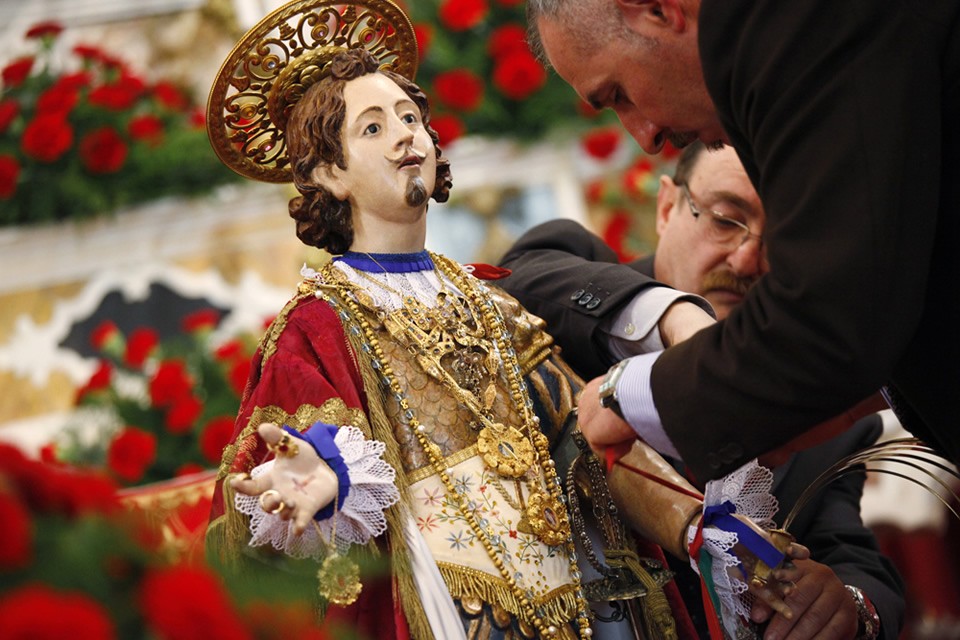
On the 1st of May 2025, Cagliari and the whole of Sardinia celebrate the 369th Feast of Saint Efisio.
This intense moment combines faith, culture and ancient traditions in a special celebration that is unique in the world, which is now ready to return to its pre-pandemic glory.
Saint Efisio was born in Asia Minor in the 3rd century A.D. and lived during the time of the Roman Emperor Diocletian. As a soldier he was sent to Italy to stop the spreading of Christianity. However, according to tradition, he converted as a result of the miraculous appearance of a shining cross in the sky, later impressed on the palm of his hand, while Christ reproached him for his sanguinary mission. Arrived in Sardinia, while his soldiers fought against the barbarians, Efisio became a Christian and defended his faith, disobeying Diocletian who ordered his martyrdom. He was executed in Nora on the 15th of January 303 A.D.
Although the devotion to the Saint started immediately after his martyrdom, the notoriety and reverence that characterize the calibration today started after the terrible plague of 1652.
The dramatic situation in Cagliari at that time caused by the loss of so many human lives lead the whole of Sardinia to join in a prayer and credited the Virgin Saint of Bonaria and the Martyr Saint Efisio for the end of the plague.
Today, as then, in gratitude for the health regained after the terrible plague, the city of Cagliari and all of Sardinia enact a reverent ceremony retracing every step of the Holy Martyr Saint Efisio. For more than 300 years, every May 1st, the whole of Sardinia accompany their patron in this traditional, unique procession retracing the steps of Saint Efisio from the place of his captivity and martyrdom in Nora to the Church of Stampace where his relics still remain.
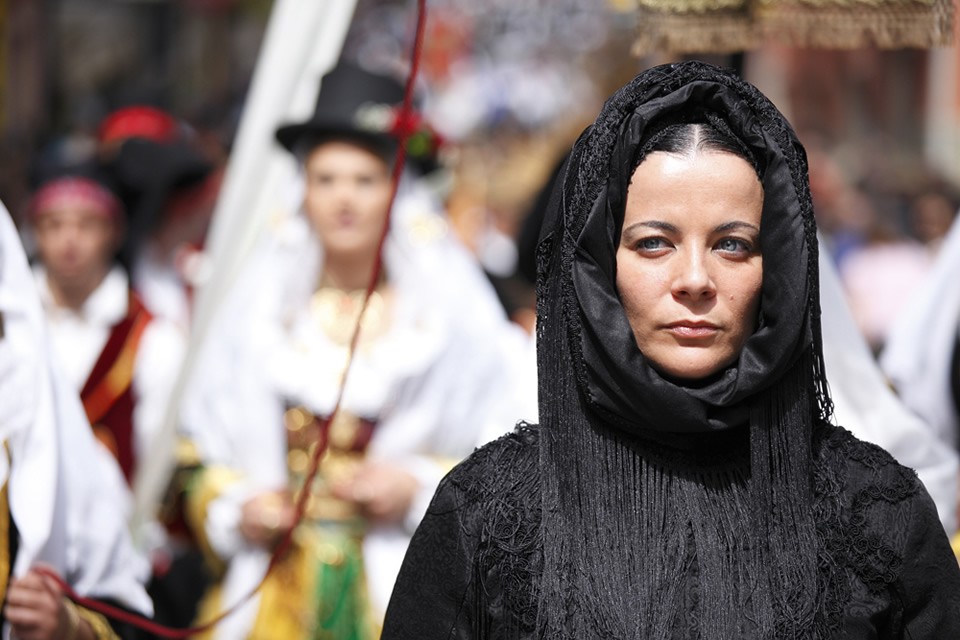
The Procession is composed by about 3,000 people, dressed with traditional clothes of Gallura, Ogliastra, Sulcis, Logudoro, Barbagia (historical Sardinian sub regions) and accompanied by 172 horsemen divided into three main groups: Campidanesi, Miliziani and Guardiania. Each group is escorted by municipal Mazzieri of the court, the AlterNos, the Clergy, and soldiers from the Army and Police officers all in their best uniforms and on horseback.
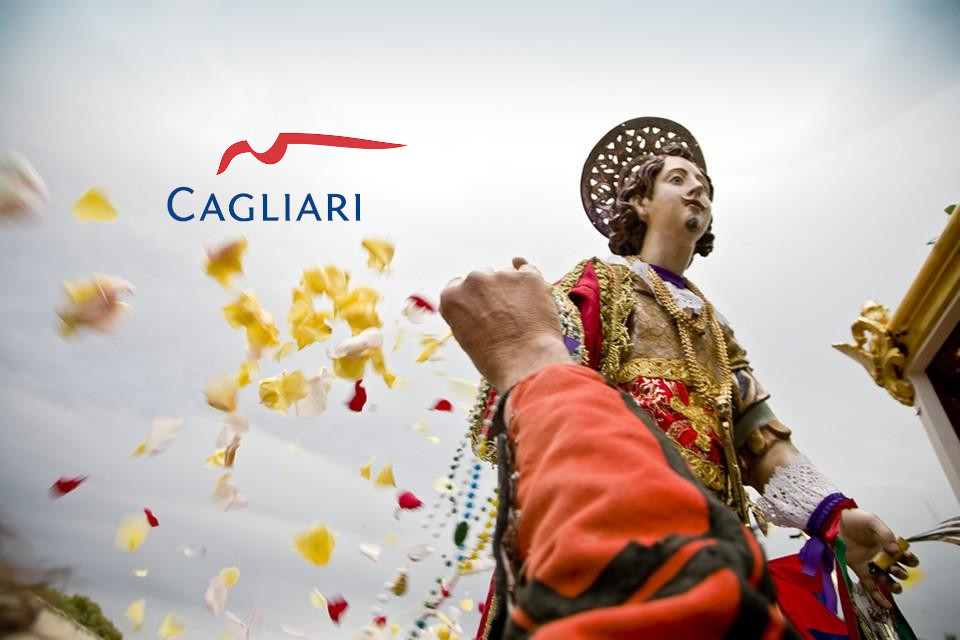
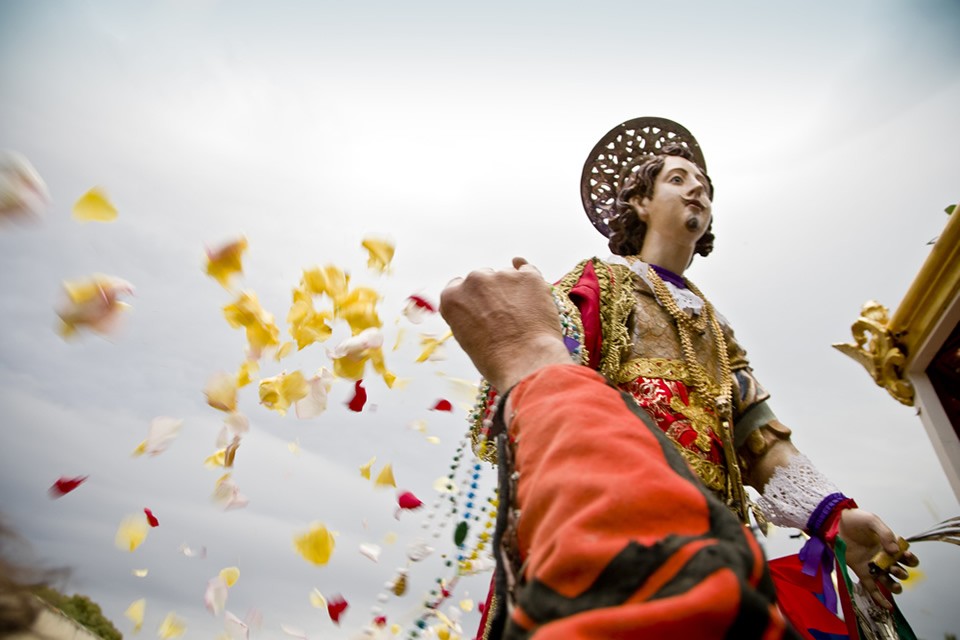
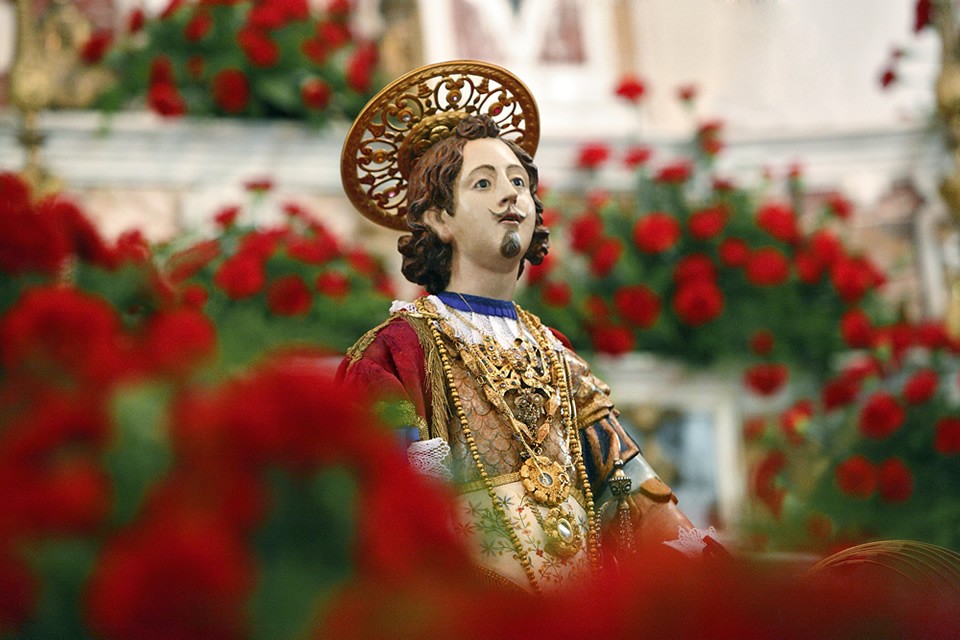
One of the most evocative moments of the ceremony is the dressing of the statue of the Patron Saint with gold and precious ornaments to prepare him for his trip.
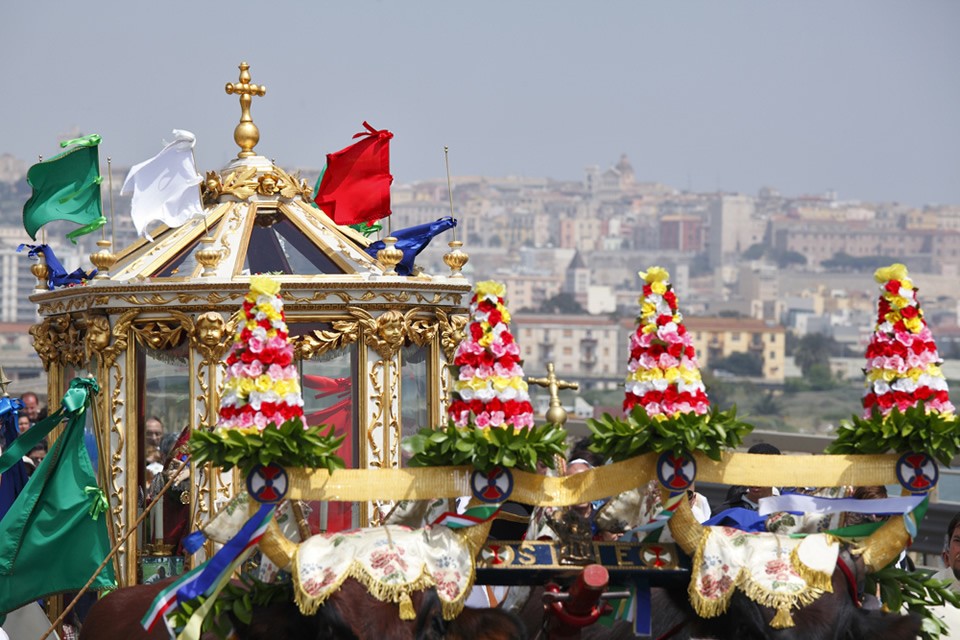
Everything is perfectly organized and planned in great detail even the choice of the oxen that pull the precious Saint's chariot and the ornaments that are kept hidden and safe until the ceremony which takes place on 1st of May.
Stay in contact with us!
Support the candidacy of the Rite of fulfillment of the Vow and the Feast of Sant'Efisio to the UNESCO Intangible Cultural Heritage List. To keep yourself up to date, check the official page facebook.com/santefisio and share the contents of our website.
turismo@comune.cagliari.it
Sant'Efisio, born in a city of Asia Minor, lived at the time of the Emperor Diocletian in the III century. A.D.
Very young he embarked on a military career and, sent to Italy to counter the spread of Christianity, he converted following the extraordinary vision of a shining cross.
In fact, for more than 300 years, every 1st of May, the Sardinian population accompanies its patron saint in this traditional and original procession, retracing the route from the prison where he was imprisoned to the place of martyrdom in Nora, to then return to his church in Stampace where his relics are still kept.
The Procession is made up of almost three thousand people wearing the traditional clothes of Sardinia coming from Campidano, Gallura, Ogliastra, Sulcis, Logudoro and Barbagia and accompanied by 172 people on horseback divided into the three main groups of Campidanese, Militiamen and the Guardiania, as well as the honour escort of the municipal Mazzieri, the AlterNos, the Clergy, the Army Representation and the Carabinieri in full uniform, also all on horseback.
One of the most evocative phases of the ceremonial is the dressing with precious gold and tinsel with which the Saint is richly prepared for his journey. Everything is perfectly organized and planned down to the smallest detail, even the choice of oxen that will pull the precious Chariot of the Saint and their ornaments deliberately kept hidden until May 1st. However, the only way to better grasp the majestic solemnity of this event is to join the lively participation of the entire Sardinian population in celebrating the greatness of its patron saint.
As far as we know, Efisio was born in Elia Capitolina, a Roman colony in Jerusalem in 250 A.D. His father, Cristoforo, was Christian but when he died, Efisio was educated to the paganism by his mother Alessandra, who had aristocratic origins. Alessandra introduced his son to the court of Antioch to the emperor Diocletian, who took him under his protection. Efisio joined the Praetorians and became an officer, so he was sent to Italy to participate to the campaign of extermination of Christians, considered enemies of the Country and of the Roman Law. At this moment, the young officer experienced an episode that changed his life: while he was marching towards Naples (or Brindisi) leading his unit, he was suddenly unhorsed by a flash. Then a voice told him: "I am Christ, the one who you persecute". Moreover, on his hand a cross was impressed.
After this extraordinary event, Efisio decided to convert to Christianity and was baptised in Gaeta. Then he moved to Sardinia to oppose the Iliesi, rebels living in the interior of the region: first, he worked in Tharros and then at the military headquarters in Nora. Despite the edicts against the Christians issued by Diocletian, Efisio started spreading the Gospel publicly and a group of followers gathered round him. Not only: he wrote to the emperor trying to convince him to abandon the false gods and to convert himself to the new religion. For this reason, he was called in Cagliari by the governor Julio, who ordered him to fall into line. Efisio refused to abjure the Christian religion, which obliged the governor to arrest him and to imprison him in a cell obtained from a cave, exactly where today the Church of Sant'Efisio is located, in Stampace district. Here, he was whipped, beaten, his flesh was stripped off and he was burnt with burning embers. However, neither his mother nor the tortures convinced him to give up. The new governor Flavian ordered that Efisio was burnt alive as an example for all the Christians, but the flames of the fire poured out the executioners. Therefore, Flavian sentenced that Efisio was beheaded in a place far from the city to avoid revolts in favour of the martyr. He was executed on the beach of Nora on January, 15th 286 (or, according to other sources, 303).
It is said that before being killed, Efisio said this prayer:
"Lord, I beg you to protect the city of Cagliari from the invasion of enemies. Please make that the people of Sardinia abandon the worship of gods, reject the tricks of the devil and acknowledge You, Jesus Christ Our Lord as Only and True God. Make that all the sick people who will pray where I am buried can recover their health and make that any- one who is in danger in the sea or threatened by the invaders or restless for hunger or thirst, after invoking me, Your servant, can be brought to safety".
The cult of Saint Efisio in Sardinia has been recorded since the 11th century, with the construction of the church dedicated to him in Nora and then with the construction of the homonym church in Cagliari in the XIII century.
The continuity of the saint's cult has uninterrupted evidence in every century.
Tradition dates the origin of the Feast to the vow pronounced in 1652, so that the Saint, Sardae Patronus insulae, could intervene on City's behalf and free it from the plague.
Over the centuries the rite has undergone some changes even if the structure has remained unchanged. The ceremony provides, between the 1st and the 4th of May, the pilgrimage of St.Efisio's statue from Cagliari to Nora and then its return to the City.
Besides the procession of the 1st of May, Cagliari dedicates to the Holy warrior three different celebrations: on January 15th it commemorates the day of martyrdom, on Holy Thursday, the so-called "tour of the seven churches" of Sant'Efisio in mourning, organized by the Archconfraternity “del Gonfalone” and, finally, on Easter Monday the statue is carried in procession into the Cathedral to honour the solemn vow done by the City of Cagliari in 1793 for protection against the French attack from the sea.
Saint Efisio is the Saint of the archdiocese of Cagliari: a deep-rooted devotion that ousted from the hearts of the people the first patron saint of the city, Saint Saturn. Efisio is venerated in different areas of Sardinia, but particularly in the southern-eastern area.
The Church of Saint Efisio in Stampace district
This church, built in 1780, is the starting point of the procession on 1st May and it is the place where the simulacrum of the Saint is prepared. Its style is Piedmontese baroque. Inside, there is still a plaque thanking the Saint for the protection granted to the city during the bombardment in 1793. Under the church, there is the famous crypt where Efisio was imprisoned before being killed.
The Crypt of Saint Efisio
According to the popular tradition, the crypt in the heart of Stampace district is the place where the martyr was imprisoned and tortured before being sentenced to death. It is a cavity nine metres under the road level where it is possible to go through some steep steps from the above church. Inside, there is a marble column called "the column of Efisio's martyrdom", where we can still see the ring to which the chain of his imprisonment was hooked.
The little church of Saint Efisio in Nora
This little church is a building of three naves, built in a primitive Romanesque style with a Franco-Catalan inspiration. It was officially consecrated in 1102. In 1656, it was restored thanks to Don Alfonso Gualbus, marquis of Palmas, as a vow for having been saved from the plague after invoking the Saint.
The relics
In 2011, the relics of Saint Efisio returned to Sardinia after 900 years. Part of the precious remains of the warrior Saint, guardian of Cagliari and Sardinia, were donated by the Archdiocese of Pisa, that had kept them since 1119, to the 151st Infantry Regiment of Sassari Brigade, at Monfenera barracks in viale Poetto. The precious silver reliquary was made by the goldsmith Francesco Busonera. The silver statue, 52 cm high, containing the relics of the warrior Martyr, is carried in procession by the 151st Infantry Regiment and precedes the chariot of the Saint all the way from Stampace church to that of Giorgino.
The three statues
There are three statues of the Saint kept in the church of Stampace.
The oldest (XVI century) is called Sant'Efis sballiau, that is "the wrong Saint Efisio", because it has the cross in the left hand and not in the right one.
The second statue (XVII century) is the one of the Feast and represents the Saint as a young Spanish aristocrat, with moustache and pointed beard.
The third was made in the XVIII century by the sculptor Giovanni Antonio Lonis and shows the Saint wearing Roman military clothes. This is the statue brought in parade on Easter Monday.
On 11th July 1652, the Municipality of Cagliari begged the Saint to protect the city from the disease, promising to honour him every year with a procession. Still today the City Administration is the guardian and guarantor of the vow dissolution. The original document of 1652 made by the Municipality is now kept at the State Archives of Cagliari.
In May 1657, the first procession was carried out: the simulacrum of the Saint was taken to the little church in Nora with the town authorities and the representatives of the cities freed from the disease. However, the Saint helped Cagliari a second time, in a marvellous way.
Between the 17th and the 18th February 1793, the French fleet led by the Admiral Truguet besieged Cagliari with a heavy bombardment. The people of Cagliari invoked the Saint and the popular troops led by Gerolamo Pitzolo warded off the French troops, that landed on the beach of Quartu Sant'Elena. The Saint was then called "the supreme commander of soldiers".
In 2014 the Municipality of Cagliari has started the procedures for the registration of the Rite of the dissolution of the Vow and the Feast of Saint Efisio in the Representative List of the Intangible Cultural Heritage of Humanity, according to the Established Principles from the Convention for the Protection of Intangible Cultural Heritage of UNESCO and in close collaboration with the Archdiocese, the Confraternity and the Municipalities of Pula, Villa San Pietro, Capoterra and Sarroch.
Here below the “gocius”, the traditional prayer verses in Sardinian language:
De Casteddu appassionau – Fond of Cagliari
Sempri siais difensori – Be always its guardian
Sighei a essiri intercessori – Continue to be its mediator
Efis Martiri sagrau. - Efisio consecrated Martyr.
The Rite of the dissolution of the Vow from 1652
The Mayor entrusts to a member of the City Council (called Alter Nos) the responsibility of the rite. About 150 brothers of the Archconfraternity escort the Alter Nos and elect the "Third Guardian" as master of ceremonies.
The Archbishop, the representatives of the Metropolitan area, the parish priests, military chaplains and other members of the clergy, perform ceremonial functions, preside over the religious rites, accompany the procession and the pilgrimage. The canon and the Alter Nos, are witnesses of the respect of the Vow's conditions and of the rite's dissolution.
The 151st Regiment "Sassari" of Italian Army looks after the relics of the Saint, takes part in the procession and carries the carriage of the Saint in some parts of the pilgrimage.
For over 350 years this rite is attended by the community of Cagliari and by those along the processional route (Giorgino, Su Loi, Villa d’Orri, Sarroch, Villa S. Pietro, Pula and Nora), by all the Ecclesiastical Province (Diocese of Cagliari, Iglesias, Lanusei, Nuoro, Oristano, Ales-Terralba, Alghero-Bosa, Ozieri, Sassari, Tempio-Ampurias) and by thousands of believers from all over Sardinia.
Tens of thousands of people take part in the rites and their preparation. In particular, the confraternities, hundreds of cultural associations and groups make along the entire year, many preparatory activities to the Rite and the Feast.
Since 1652 the Municipality has always and continuously respected the Vow and today its role is still important. In fact, every year: the financial statements of the City of Cagliari includes resources for the dissolution of the Vow; the mayor appoints the Alter Nos and the event includes, along with the Municipality, the active participation of associations, groups and lovers of Sardinian tradition.
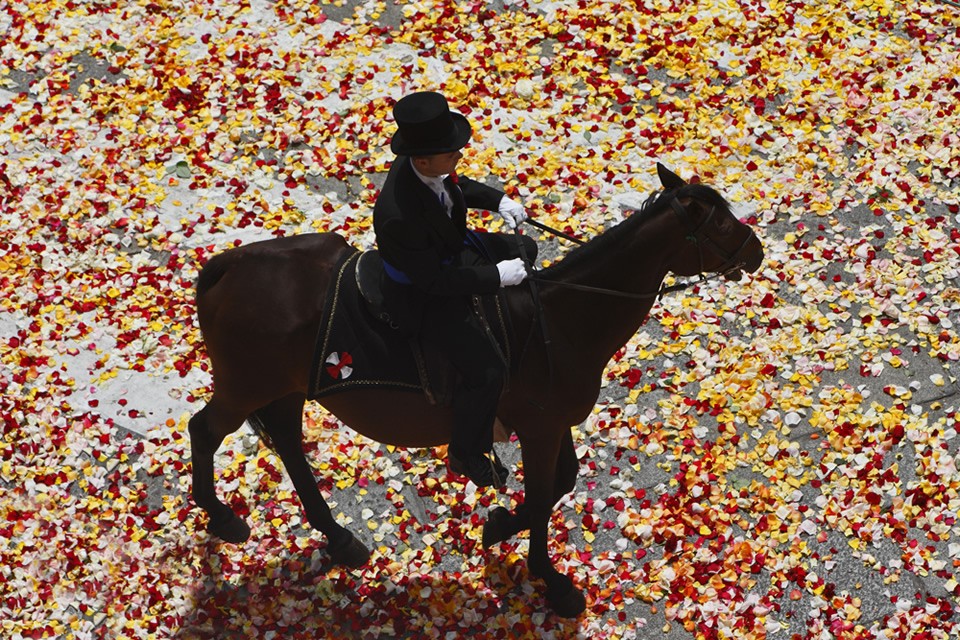
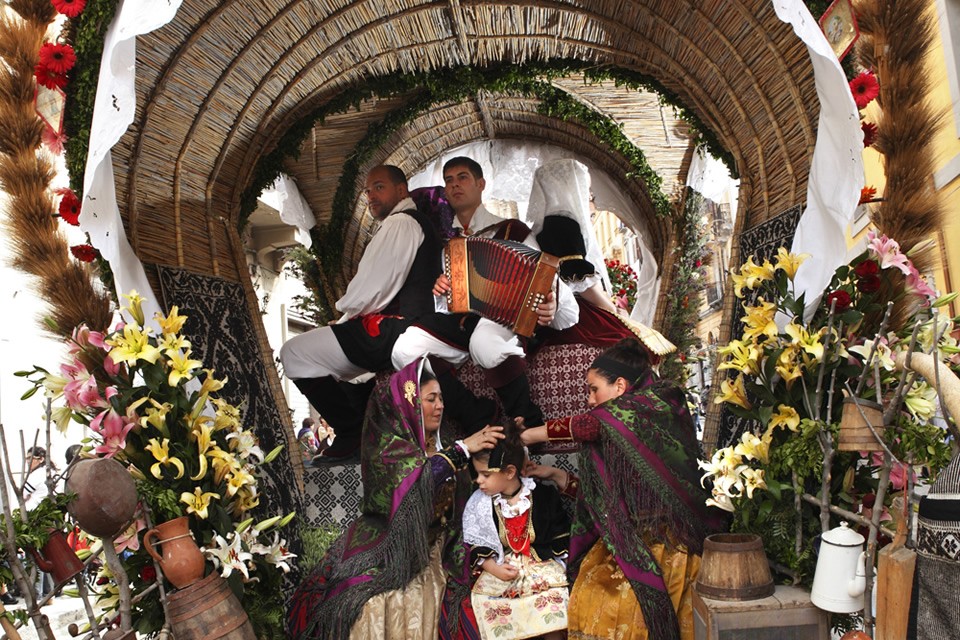
On the 1st of May, the procession is opened by the Tracas which are carts towed by decorated oxen. To the feast, thirty or forty carts usually participate coming from different towns of the province of Cagliari. Then, there are folkloric groups wearing typical Sardinian clothes who sing or say some prayers of Sardinian tradition called gocius. Behind these groups, there are the horses. The Cavalieri del Campidano (Campidano's Horsemen) start the parade with horses decorated with cockades and rosettes. After them, it is the turn of the Miliziani (Militiamen) with arquebus and sabres. The procession with the horses continues with the Guardianìa, wearing a tailcoat, a top hat and a blue strip in the hips. In the front row, the Third Guardian keeps the standard of the Archconfraternity.
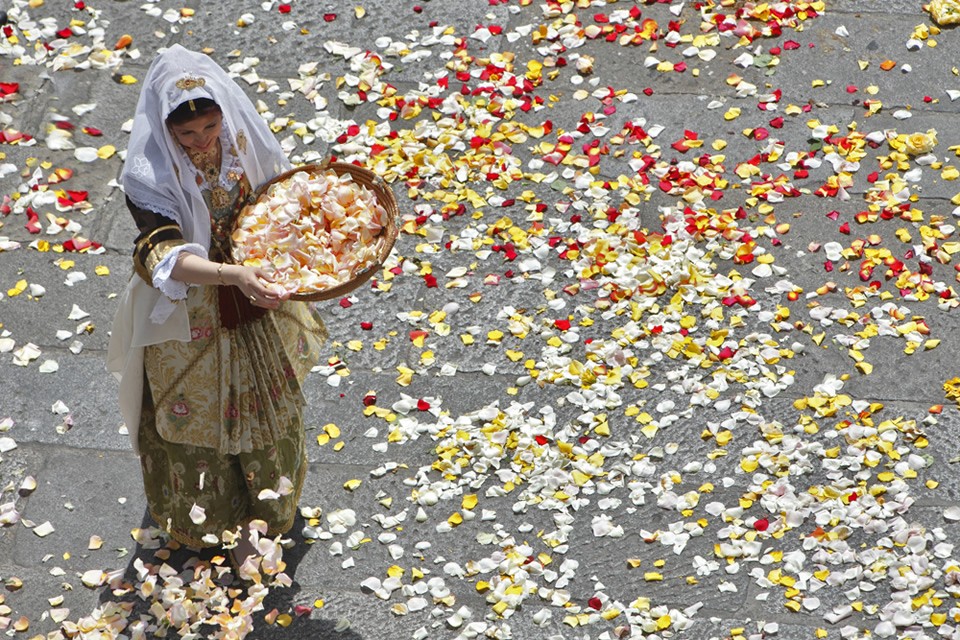
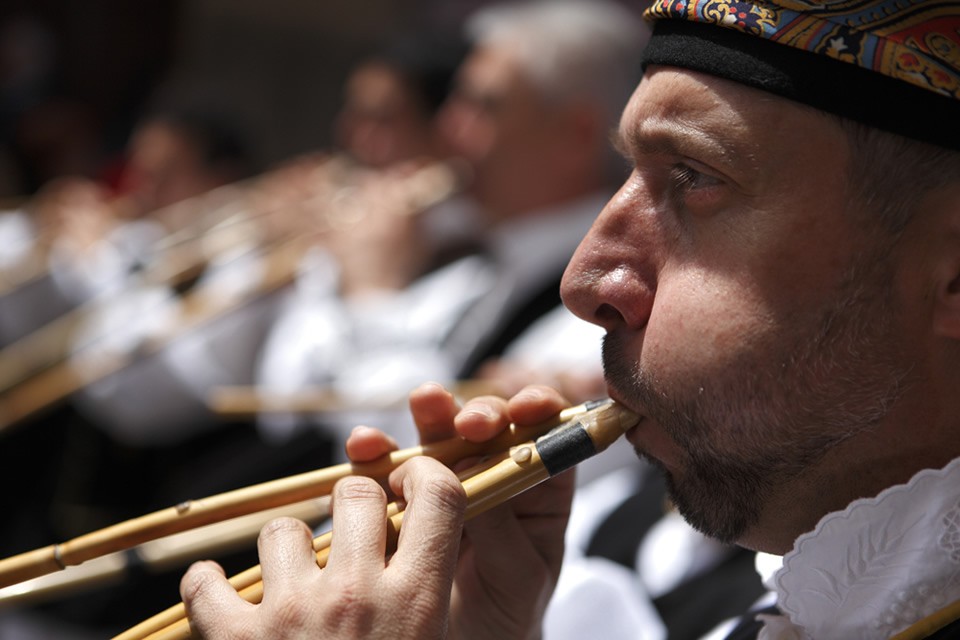
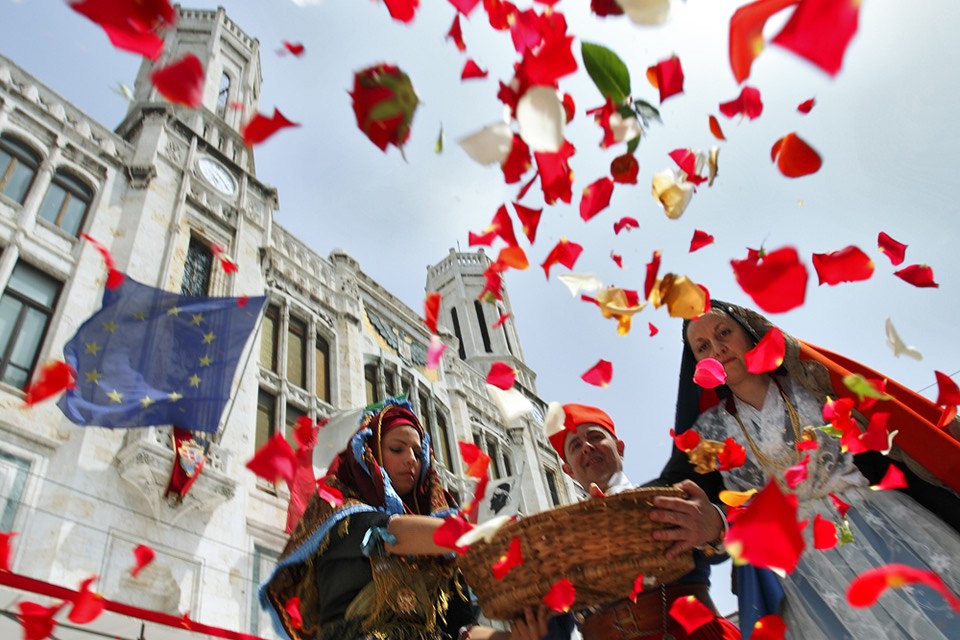
With a tailcoat, a top hat and a strip representing the Italian flag the Alter Nos, representing the mayor of Cagliari, continues the procession along with the members of the Archconfraternity of the Gonfalone. The first of them keeps a crucifix of the XVIII century. Two of them called "the Collaterals" stay on the sides of the cart to open its doors to allow people to put flowers, offerings, ex voto and supplications in, when the procession stops. The arrival of the cart with the simulacrum is announced by the sound of launeddas, a typical Sardinian wind instrument. A big yoke of oxen decorated with flowers and driven by Su Carradori tows the cart. In Via Roma, in front of the dignitaries' stand the cart continues its procession on a carpet of flowers (sa ramadura), welcomed by the sirens of the boats docked in the port. This is a touching moment, also because the crowd goes towards the Saint to beg for a grace. Then the cart continues its road to Nora with the believers who made the vow to walk.
In the afternoon of 1st of May, the Procession stops in Giorgino in a small private church dedicated to Saint Efisio. All the jewels are removed and the clothes are replaced by simpler ones. The statue is put in a travelling coach. Then the procession continues to Maddalena Spiaggia, where many devotees come from the near town Capoterra (called before the city of Saint Efisio).
The third stop is done at "Su Loi", where a Mass is celebrated. At sunset, the procession arrives at the chapel of the beautiful Villa d'Orri of the marquis of Villa Hermosa where Eucharistic blessing is given. At the end, the procession starts again and arrives at Sarroch. The cart is led to the church of Santa Vittoria where a solemn Mass is celebrated and here people will stay to sleep.
On the 2nd of May, the procession arrives at Villa San Pietro, town introduced in the feast in 1943, and then at Pula. At about midday, the coach arrives at Pula and the town and religious authorities welcome it. On the bridge called "Su Rondò", the Alter Nos entrusts to the mayor of Pula the task to go on with the celebrations.
Then, in the church of San Giovanni Battista, a solemn Mass is celebrated. After a stop in front of the cemetery and in front of the little church of San Raimondo, the Saint is given to the Archconfratenity and escorted to Nora where it arrives at around 9 p.m.
The simulacrum is then put in a niche. During the whole day, on the 3rd of May the Saint is commemorated with masses and celebrations. At 6 p.m., there is the procession along the coast and the Saint is taken out of the coach and carried on shoulders to visit again the place of his martyrdom. The 4th of May is the day of the return and the same itinerary is done to go back to Cagliari.
The Confraternity was founded in Cagliari in 1564, in 1618 it was joined to the Roman Archconfraternity “della SS. Vergine del Riscatto” and then promoted to Archconfraternity in 1796, with papal bull of Pope Pius VI, following the liberation of the city and the whole island from the Franco-Piedmontese invasion.
It always pronounces the dissolution of the Vow to the City of Cagliari and the Archbishopric, in the evening of May 4 by midnight: the president of the Archconfraternity pronounces the dissolution of the Vow in front of the civil and religious authorities, as well as to the devotees.
It is one of the oldest popular associations of Cagliari, which has seen over the centuries the membership of famous people, including the Savoy sovereigns Carlo Emanuele IV, Vittorio Emanuele I, Carlo Felice and their wives.
To become brothers, it is necessary to have a permission by the own parish and a formal request.
For two years the brother is supervised by the novice master, at the end of which, after a swearing ceremony, he wears penitential clothes: a blue garment on which a white and red cross is sewn and a whip on the left side, a white woollen small cape and a cord with a rosary.
The Archconfraternity has its headquarters in the Church of Saint Efisio, in Stampace district and today it has about one hundred and fifty members, divided in two distinct male and female branches of brothers and sisters.
The members of the Guardianìa, also called "Is Dottoris" (because in the past they were notable citizens) have the role of “honour guard” of the Saint.
The Guardianìa was part of the Archconfraternity entrusted to take care of the processions and the functions of Thursday and Good Friday.
The Third Guardian is the Feast's representative and the main responsible for its organization. In particular, the Third Guardian, that brings in procession the banner of the Archconfraternity, was also responsible to travel to Pula for the transfer of the simulacrum of Sant'Efisio.
The Third Guardian will not be present at the 369th Feast of Sant'Efisio.
The Alter Nos
The Alter Nos represents the Municipality of Cagliari and in the ceremony symbolizes the official public thanks to the Saint.
At the time of the monarchy (the Spanish first, then Savoy) it was the Viceroy that, on behalf of the king, walked in procession for the Feast of Saint Efisio.
Today, this role is performed by a member of the City Administration.
The Alter Nos choice is at the discretion of the mayor, who confirms the appointment in April. After the appointment, the chosen one takes riding lessons, chooses the accessories for his tailcoat and starts taking part in the events of the Archconfraternity.
On May 1 the mace bearers, official guides of the highest town officers, lead the Alter Nos to the Town Hall in the presence of the Mayor. Here, in front of the Guardianìa, the official investiture takes place.
The Mayor decorates the Alter Nos with the "Golden Fleece", a solid gold medallion donated in 1679 by Charles II, King of Sardinia and Aragon. On the Golden Fleece stand effigies of the towers and the Savoy cross. Decorated with this jewel and bandaged by the tricolour, the Alter Nos proceeds towards Sant'Efisio's church where, at eleven the solemn Celebration in his honour takes place. During the Mass, sung in Latin, The Alter Nos is religiously consecrated, enclosing the two aspects of the Feast: civil and religious.
The representative of the Municipality follows the chariot of the Saint even in the later stages out of town until the return on May 4 in the church of Sant'Efisio.
The Alter Nos for the 369th edition of the Feast of Saint Efisio will be Marzi Cillocu
Tribuna n. 1: tribuna coperta sita in via Roma lato Palazzo Vivanet con vista Piazza Matteotti
€ 40.00
Tribuna n. 2: tribuna scoperta sita in piazza Matteotti, con vista verso la stazione ferroviaria.
€ 30.00
Tribuna n. 3: tribuna coperta sita in via Roma, lato piazza Matteotti, con vista su Palazzo Vivanet.
€ 45.00
Tribuna n. 4: tribuna coperta sita in via Roma, lato piazza Matteotti, fronte Palazzo Civico.
€ 45.00
Free entrance
Tribuna n. 6: tribuna scoperta dislocata in piazza del Carmine, con vista su viale Trieste.
€ 30.00
Cagliari folk groups: Quartiere Villanova
Cagliari Folk Groups – Quartiere Villanova
Cagliari Folk Group owes its name to one of the most ancient districts of the town: Villanova quarter, that still cherishes some of the most ancient traditions of Cagliari. It was established in 1976 by a group of young people joined together by the interest for folklore and by a strong will to recover their own roots, that culminated in 1980 in the re-enactment of the wedding ceremonial according the tradition of Cagliari, documented in the book “Cagliari amore mio” by Cenza Thermes.
In 2006, the in-depth analysis of popular customs and traditions of Cagliari and its hinterland led the group to organise the ethnographic exhibition “Panetteras, arregatteris e piccioccus de crobi” , hosted by the Citadel of Museums, in which the Association showed its collection of clothes, both original and reconstructed, jewels, photos and ancient prints.
The activity of the Folk Group consists especially in performing choreographies within village feasts, where Sardinian religious and social traditions still express themselves in a faithful historical memory.
The dance group wears precious 18th and 19th century costumes of the town and performs a rigorously traditional repertory of ancient Sardinian dances, accompanied by the archaic sound of launeddas (Sardinian triple clarinet) and melodeon (diatonic button accordion).
The beauty of their costumes and their grace in dancing, bear the approval and the recognition of qualified observers. As a member of the F.I.T.P. (Italian Federation of Popular Traditions), patronised by UNESCO, the Group represents Sardinia and Italy in the most important national and international folklore festivals. In 38 years of activity, the Association has taken part to about 40 International Folklore Festivals in almost all the continents.
Women’s clothing
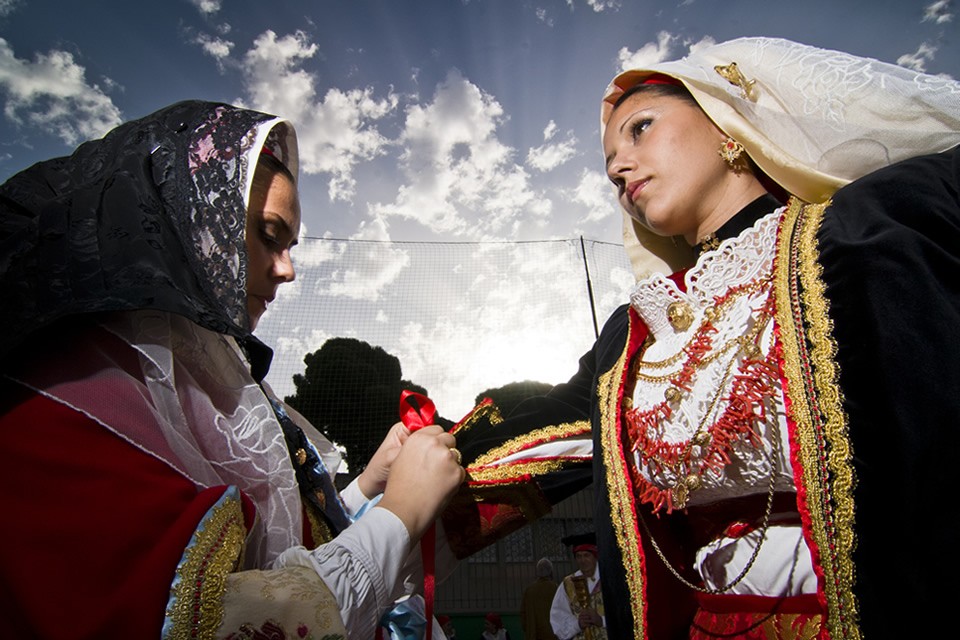
Female costumes have similar shape but usually change their colours depending on the owner’s taste. The everyday clothing was named “su bestiri de andiana”, after the skirt fabric. It is made up of the skirt, the shirt, the vest and the shawl crossed over the chest, with numerous jewels pinned on it. Hair is tied in a triangular kerchief called “su turbanti” on which lays another kerchief and a shawl, whose characteristics change according to the social status of the woman.
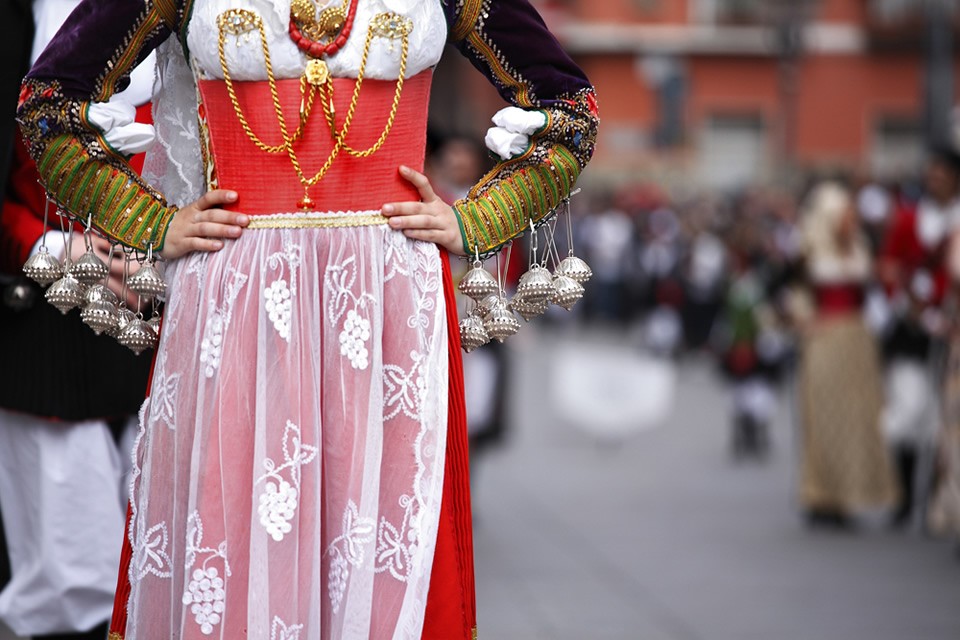
The costume worn on important feasts is called “su bistiri de sa panettera”. The reason why such an elegant and sumptuous clothing derives its name from a working woman (“sa panettera”, the baker), and not from a noble one, is purely historical: the last women who used to wear this costumes where the “panetteras” from the quarter of Sant’Avendrace. Its refinement is impressive, as well as its similarity to the 17th and 18th Iberian- Balearic costumes. In Cagliari, it used to be worn as a wedding dress, and then again on the most important feasts in a woman’s life. The costume is made up of a light blue satin skirt (“fardetta”) under a tulle apron (“deventali”), a shirt covered by a black vest (“gipponi”) and an embroidered shawl, the “mucadori a perra”. Hair is tied in a silk bonnet (“cambiscu”) covered by a red cape (“mantiglia arrand’e pratta”).
“Su bistiri de seda” (silk clothing) dates back to the end of the 19th century and shows the influence of the fin de siècle style.
Men’s clothing
Men’s clothing have different characteristics depending on the Guild. “Su carradori”, who accompanies the Saint’s carriage and leads the oxen, wears a red doublet with a black border “sa facchina”. The truncated cone shaped hat “su pibironi” is clearly influenced by the Moorish style.
“Su carrettoneri” (the carrier) wears a black and white costume with a black cap. The only coloured feature is the red waistband “sa fascadroxa”. “Su piscatori” (the fisherman) wears a shirt and a silk gilet. The red zoot trousers are completed by a sash, a black or blue jacket and a red truncated cone shaped hat. This is surely the costume that shows the greatest number of characteristics derived from the Mediterranean style.
Clearly influenced by the Spanish clothing, instead, is the greengrocer’s costume, that includes a bolero and a large brim hat called “su sombreri”.
The milkman’s costume, recently reconstructed thanks to some 1940’s prints found in Rome, is characterized by a red kilt and a blue jacket.
Contact the Folk Group
Address: Via Montegrappa 4/a - 09122 Cagliari
Website: www.gruppofolkcagliari.it
Facebook: Gruppo Folklorico di Cagliari Quartiere Villanova
Cagliari Folk Groups: Villaggio Pescatori Giorgino
Giorgino is a very particular historical and geographical reality: the neighbourhood was founded in 1939 under the fascist regime to create housing for local fishermen. So close and yet so far away from the city, its inhabitants continue to keep alive the traditions and the customs of the village.
In this sense, Saint Efisio plays a predominant role for the community of Giorgino: the fishermen are the only ones that lead the martyr to the little church in their village. Here the city and luxurious clothes of the Saint are taken off, to make him wear the more humble ones of the countryside.
The costumes worn by the inhabitants of Giogino are very simple in their workmanship, almost devoid of jewels and symbolize in their colours the strong relationship between those who live in the village and the sea.
Men's clothing
The traditional male suit consists of a pair of trousers, a white cotton shirt and a black skirt. The group leader wears a red sash tied around the waist. A distinctive feature of men, is to not wear shoes, in fact, during the fishing in the ponds, shoes were not used.
Women's clothing
Women wear a shirt, similar to the men one, on which is placed "su gipponi", the snug black jacket. They use a pleated skirt, whose amplitude is 4-5 meters, which allows it also to be worn by pregnant women. On this skirt is laid "su deventali'", a damask blue and green skirt, that shines like the sea under the sun. On the head they wore a black handkerchief tied like a turban, on which is placed a delicate white silk handkerchief and finally a colourful scarf, according to the style and the economic means of the owner. The Women of Giorgino don't wear many jewels: just the golden button of the shirt and some precious ornament in silver filigree. The traditional dress expects that the shirt is rolled up on the chest in order to create an important "v-neck", that highlights the prosperous breast of the fishermen's women.
Source: Press office Municipality of Cagliari. Special thanks to Mrs Irene Mura and the cooperative "Non solo mare”.
In 2014 the Municipality of Cagliari has started the procedure to inscribe the Rite of fulfillment of the Vow and the Feast of Sant'Efisio in the Representative List of the Intangible Cultural Heritage of Humanity, according to the criteria established by the Convention for the Safeguarding of the Intangible Cultural Heritage and in collaboration with the Archdiocese, the Confraternity and the Municipalities of Pula, Villa San Pietro, Capoterra and Sarroch.
The Municipal Administration is strongly committed to initiatives to safeguard all cultural heritage, but they must be especially citizens and participants in the Feast of Sant'Efisio to contribute actively and concretely to the preservation of cultural assets.
For this reason we ask you to support the candidacy of the Rite of the fulfillment of the Vow and the Feast of Sant'Efisio to the Representative List of the Intangible Cultural Heritage, through all the appropriate actions of transmission and protection.
As an integration to the work of safeguarding, an official page dedicated to the Feast has been created on Facebook to publish all the news about religious rites, history and curiosities about the Feast: https://www.facebook.com/santefisio
Citizens and associations can also support the nomination and send prompts to: santefisio@comune.cagliari.it
On the 12th of March 2014, the Municipality of Cagliari, together with the municipalities of Pula, Villa San Pietro, Capoterra and Sarroch, the archiepiscopal Curia Diocese of Cagliari, the Regional Directorate for Cultural Heritage and Landscape of Sardinia (Ministry of Culture and Tourism) and the Superintendence of Architecture, Landscape, Historical, Artistic and Ethno-anthropological Heritage of the Provinces of Cagliari and Oristano (Ministry of Culture and Tourism) signed the Protocol of Agreement for the implementation of safeguard measures of the "Rite of fulfilment of the Vow and the Feast of Saint Efisio".
The Protocol is a programme of activities aimed to protect and preserve the cultural diversity, the biodiversity and the cultural, artistic, religious, historical and environmental context of the area involved in the Rite, with particular attention to the territories crossed by the Saint along the processional path during the Feast of May 1- 4, according to the Unesco Conventions.
The Municipal Administrations and their scientific and religious communities have committed to start a strategic plan to make the Path of Saint Efisio entirely available all year round, including churches, places of worship, areas of environmental, archaeological, historical and cultural interest throughout the route.
By Decree n. 2 (5 February 2015), the Regional Administration has enrolled the Path of Saint Efisio in the Register of the religious and spiritual itineraries. This important recognition marks another milestone in the programme of preservation and enhancement of the Feast of Saint Efisio, launched by the underwriters of the Protocol.
The landscape shared by the five municipalities is increasingly becoming a resource for a new form of tourism, based on the environmental patrimony and the culinary excellences, and represents a key component of Sardinian cultural and natural heritage. The lagoon of Santa Gilla, the coasts and the fields, to name a few, as well as the historical and archaeological sites along the path, like the ancient town of Nora or the nuragic complex Antigori in Sarroch. Together with the other underwriters, the Municipality of Cagliari, leading the protection project, promotes a landscape – conscious culture, for a wider and wider popular participation in the territorial administration.
April 25th 10.00 am The Cart of Saint Efisio enters inside the church 11.00 am The flag and the standards are consigned to the Militiamen (Miliziani) 6.00 pm The flag is consigned to the Third Guardian
April 29th Ceremonial dressing of the Simulacrum
April 30th 10.00 am Ceremonial ornament of the Simulacrum with golden votive jewels 12.00 pm Holy Mass for the enthronement of Saint Efisio into the Cart, presided by Monsignor Giuseppe Andrea Salvatore Baturi, Archbishop of Cagliari. 7.00 pm Solemn pontifical 8:30 pm pm Prayer vigil
May 1st 6.00 Holy Rosary in Sardinian Language 7.00-8.00-9.00-9.30-10.00 am Holy Masses at the Crypt of St Efisio 11.00 am Celebration of the Alter Nos Holy Mass.
12.00 pm Departure of the Cart from the Church of St Efisio, following the processional path: (Via Azuni, Piazza Yenne, Corso Vittorio Emanuele, Via Sassari, Piazza del Carmine, Via Crispi, Via G.M. Anjoy, Via Mameli, Largo Carlo Felice, Via Roma (City Hall side), Via Sassari, Viale La Playa, Villaggio Pescatori in Giorgino at the Church of Staint Efisio (arrival around 3 p.m); At the arrival in Giorgino, the Simulacrum changes its clothes and cart.
4.30 pm From La Maddalena Spiaggia, the procession continues along the Provincial Route up to Frutti D'Oro. After the celebration of the Holy Mass in Su Loi, the procession stops at Villa d'Orrì for the Eucharistic Blessing in the private chapel of the Marquis of Villahermosa. 6.30 Sant'Efisio Vespers 7.00 pm Holy Mass at the Church of Saint Efisio in Cagliari
May 2nd 8.00 am The pilgrimage continues from Sarroch to Villa San Pietro, towards Pula 12.30 pm Arrival in Pula at the Church of Saint Giovanni Battista 6.00 pm Departure towards Nora 6.30 Sant'Efisio Vespers 7.00 pm Holy Mass at Saint Efisio Church in Nora
May 3rd Ore 8.00 - 9.00 - 10.00 S. Messe - Nora. Ore 9.00 S. Messa (chiesa di Cagliari) Ore 11.00 Solenne Pontificale presieduto da S.E. Mons. Giuseppe Baturi Arcivescovo di Cagliani. Ore 17.30 S, Messa - Nora Ore 18:30 Processione con il simulacro di SantEfisio lungo il percorso che porta agli scavi di Nora con rientro dalla spiaggia. Partenza di Sant Efisio alla volta di Pula Ore 18.30 Vespri di SantEfisio. (chiesa di Cagliari)
May 4th 7.30 am Beginning of the pilgrimage to Cagliari, through Villa San Pietro, Sarroch, Villa d'Orrì, Su Loi, Maddalena Spiaggia and Giorgino, where the Simulacrum changes clothes and Cart 8.00 am Holy Mass in Nora in honour of the dead brothers 9.00 am Holy Mass at the Church of Saint Efisio in Cagliari 6.30 Sant'Efisio Vespers followed by eucharistic blessing ( Church in Cagliari) 8.00 pm The procession moves from Villa Ballero in Giorgino towards Cagliari 10.00 pm The simulacrum arrives to the Church of Saint Efisio in Stampace (Cagliari)
After the Eucharistic Blessing, the president of the Archconfraternity proclaims the fulfilment of vow
May 5th 8 am-9 am Holy Mass
From the 5th to the 25th of May, in the afternoon, a “Novena” is read in honour of the Saint
May 22nd Santa Rita Feast 12.00 p.m. Holy Mass - Blessing of the Roses - Supplication to St. Rita 7.00 p.m. Holy Rosary. 7.30 p.m. Blessing with removal of SantEfisio from the Cart.
May 23th-24th-25th Solemn 40 hours 6.00 p.m. Eucharistic Exposition 7.00 p.m. Holy Rosary - Eucharistic Blessing - Holy Mass (only on May 24th)
May 25th 9.00 a.m. Holy Mass 6.00 p.m. Eucharistic Exposition 7.00 p.m. Holy Rosary 7.30 p.m. Procession through the streets of Stampace with the Blessed Sacrament on the return to the Church singing of the Te Deum, Eucharistic Blessing and singing of "Is Goccius' The celebrations for Sant'Efisio ended.
The initiatives that mark the wait for the feast of the Saint and the following days, before your return, there will be events of high cultural and musical value from imagine as a real evocative interface, where the city of Cagliari becomes a reference for the whole region to help disseminate some of the most important ethnomusical expressions of the island's intangible heritage oral tradition.
On April 30th at 9:00 pm, the day before the solemn feast, there will be a concert led by Cagliari-based group SA RATAPIGNATA, which was founded in 1998 and recently reunited after a period of dissolution. The group will perform its most famous songs in the Sardinian language, mixing styles, rhythms, and sounds that are highly appreciated in Sardinia and at international festivals.
May 1st at 6 pm Piazza Del Carmine
"The Festival of Tradition" As usual, on the evening of May 1st, from 6 pm in Piazza Del Carmine, popular Sardinian dance becomes an opportunity for strong involvement collective with the participation of 24 regional folk groups and the maestro delle launeddas Luigi Lai. The evening will be opened by the delivery ceremony of the "Toson d'Oro" award of the Municipality of Cagliari assigned this year to the Professor Marco Lutzu.
May 2nd at 8 pm Bacaredda Palace Courtyard
The concert aims to explore the female musical and singing tradition of Sardinia, presenting a repertoire of typical songs from different areas of the island. Performers will include Sara Satta, Noemi, and Gianfranca Mulas with monodic songs from Logudoro, and Maria Teresa Pirrigheddu with guitar songs from Gallura. Additionally, Dolores Dentoni will perform "a chitarrina" songs, while Francesca Vacca will present folk dances accompanied by a small accordion. The concert will last approximately two hours and will be introduced by ethnomusicologist Prof. Marco Lutzu, who will provide useful information to fully enjoy the event.
May 3rd at 8 pm Bacaredda Palace Courtyard
The evening will focus on the tradition of four-part singing, represented by forms such as “tenore” and “cuncordu,” which are important expressions of Sardinian culture and have been recognized as intangible cultural heritage by UNESCO since 2005. Renowned groups will perform, including Tenore di Bitti Remunnu ‘e Locu and Tenore Santu Gavinu di Oniferi. The event will last approximately two hours and will be introduced by Prof. Marco Lutzu, an ethnomusicologist from the University of Cagliari, who will explain the characteristics and improvisation techniques of this expressive form.
May 4th at 6 pm Bacaredda Palace Courtyard
"The Sardinian chorus for Sant'Efisio" While waiting for the saint to return to the city from 6 pm to 8 pm, six o'clock choirs that will greet the passage of the Saint in the main streets of the route, will give life to a concert of sacred and profane songs from their own musical repertoires. The polyphonic choirs participate: Associazione Culturale Coro Polifonico Cantos de Jara – Gesturi; Coro Kellarious di Selargius; Coro Serpeddì di Sinnai; Coro Voci in Musica Serri; Coro Terra Mea Cagliari; Coro S’Arrodia di Sinnai; Coro Carrales di Cagliari; Coro di Cagliari. At the end of the concert, the choral formations will position themselves in the places established for greet the passage of the Saint with the gocius and chants of the religious repertoire. Six o'clock locations will be as follows: Civic Palace entrance; Via Sassari alongside Tar; Via Sassari at the corner with Corso Vittorio Emanuele; Corso Vittorio Emanuele – corner with Piazza Yenne; via Azuni ladders church of S. Anna; Church of Sant'Efisio.
4th May at 9 pm Viale La Plaia area - city route
"The torchlight vigil for Sant'Efisio" As usual, Sant'Efisio's return to the city will also be welcomed by the songs of the rosaries of the approximately 1,800 devotees in traditional clothing mainly from from the southern area of the island, and from the presence of about 150 Campidanese knights e 56 mounted militiamen. The procession will precede the passage of Sant'Efisio on the way up to the church of Print it.