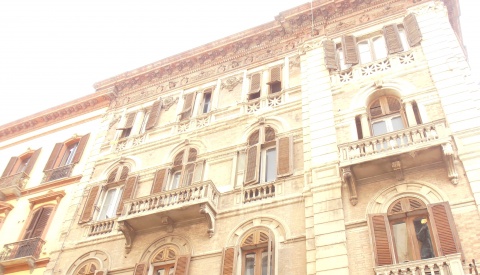
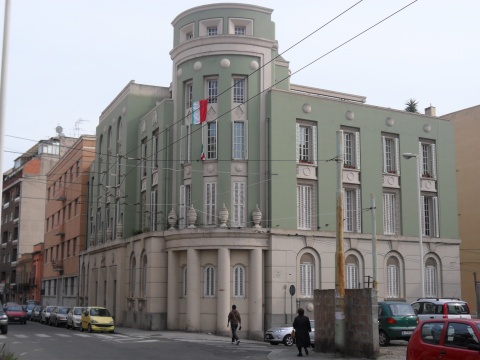
Microcythemic Hospital
Ospedale Microcitemico
Via Jenner
Add new review
Your review will be visible after approval by the editors
To post a review you must be an authenticated user.
Log in with Social Login
Ospedale Microcitemico
Via Jenner
Your review will be visible after approval by the editors
To post a review you must be an authenticated user.
Log in with Social Login
Ospedale Marino
Viale Lungomare Poetto, 12
Your review will be visible after approval by the editors
To post a review you must be an authenticated user.
Log in with Social Login
Oncological Hospital
Ospedale Businco
Via Jenner
Your review will be visible after approval by the editors
To post a review you must be an authenticated user.
Log in with Social Login
Ospedale Brotzu (Azienda ospedaliera Brotzu)
Piazzale Ricchi, 1
Your review will be visible after approval by the editors
To post a review you must be an authenticated user.
Log in with Social Login
Commonly called sanatorium
Ospedale Binaghi
Via Is Guadazzonis, 3
Your review will be visible after approval by the editors
To post a review you must be an authenticated user.
Log in with Social Login
The garden of the Capuchins friars was built in 1595 on a hill on the west side of the Roman Amphitheatre . The Convent of the Friars had a vast tract of land used as a garden for the cultivation of medicinal plants, in which there were some ancient cisterns of the Roman Period.
From Vico I Merello there is the access to the vast area called the "Garden of the Capuchins". In 1595, the Capuchins had founded on the hill to the west of the Amphitheatre their first convent in Sardinia, provided whith a large land used as a vegetable garden, and incorporating some ancient cisterns in their lot. The monastery grew rapidly, considering that in 1649 it included not less than 65 cells for the monks, in addition to the kitchen and the refectory. Such a rapid development of the convent, with the presence of a woolen mill, an infirmary and a large garden for the cultivation of medicinal plants, was made ​​possible only thanks to the availability of a large amount of water, especially guaranteed by the presence of a cistern into which, thanks to a complex work of channeling, rain water flowed. Capuchin Father Giorgio Aleo, a famous author of "Chronological History of Sardinia" relates a story on Cagliari plague of 1656, which probably refers to the cistern of the Garden of the Capuchins. The Aleo writes that in the last days of May 1656 the mortality in Cagliari became so high, that there were not grave-diggers enough to bury the dead. Faced with a growing number of unburied corpses, the magistrate health then decided to bury the dead in wells and cisterns and the dead in Castello quarter ended in an old cistern close to the Capuchins.
In the garden of the Capuchins, now owned by the city, there are several monumental cisterns dug into the limestone rock for a long time attributed to the Punic period. However these are instead quarries of building blocks opened perhaps in the I-II century AD, for the construction of the nearby Roman amphitheater. They were used as tanks at a later time, once waterproofed with earthenware (a lime plaster mixed with shredded pieces). The largest could hold up to one million liters of rainwater coming from the amphitheater through a long underground tunnel still viable. Thanks to various exploration carried out in 1997 by the Speleological Group Specus through the cavity, it was found that in ancient times the cave suffered a further readjustment in old prison, as evidenced by the numerous metal rings observable along the walls intended for fastening the chains. At one of these was discovered an important early Christian graffito, perhaps dating back to the early 4th century AD. This would be, according to a hypothesis of a symbolic image of Navicula Petri, the ship of the Church, with the tree of sailing consisting of a monogrammatic cross and on the deck the twelve Apostles, "fishers of men", schematically represented throwing the nets. The author should probably be identified in an unknown Christian martyr, detained before being killed, perhaps in the games of the amphitheatre.
Orto dei Cappuccini
Viale Merello, 59
Your review will be visible after approval by the editors
To post a review you must be an authenticated user.
Log in with Social Login
The Botanical Garden was opened in 1866 under the direction of Prof. Patrizio Gennari.
Nowadays, it contains about 2,000 species, predominantly of Mediterranean origins, but with a good collection of succulent and tropical plants as well. The garden is divided in three main sections:
- plants from Mediterranean, which represent the main three sections of the vegetation in Sardinia, as well as the species coming from Australia, California and Chile;
- succulent plants, about 1,000 species of plants such as the Echinocereus, Euphorbia, Lamphrantus, Mammillaria, Opuntia, etc, grown in greenhouses and outdoor, almost equally split between species from Africa and America;
- tropical plants.
All in, the garden contains about 600 trees and 550 shrubs. Of special merit is the area dedicated to the collection of palms (stretched for 4000 m2) with about 60 species of Euphorbia canariensis, with the extension of 100 m2. The garden area has also a considerable archaeological importance because of the presence of tanks and wells from the Roman period.
Orto Botanico
viale Sant’Ignazio da Laconi, 9-11
Your review will be visible after approval by the editors
To post a review you must be an authenticated user.
Log in with Social Login
Built between 1665 and 1667 in the Baroque style, it is the seat of the "Arciconfraternita della Solitudine", which curates the rites of Holy Week. It preserves the wood carvings called "Is Misterius", which are taken in procession on the Friday.
The oratory of the Santissimo Crocifisso is a church in the Villanova district, overlooking San Giacomo Square and it is adjacent to the homonymous church. It is the seat of the Archconfraternity of the Most Holy Crucifix, the protagonist of the rites that take place during the Holy Week. The small Baroque temple was erected in the second half of the seventeenth century over an existing building. The facade is divided into two mirrors and a portal opens on each mirror. Inside stands a majestic high altar in gilded wood and there are also eighteenth-century statues, work of Antonio Lonis that is used in Easter processions.
Oratorio del Santissimo Crocifisso
Piazza San Giacomo
Your review will be visible after approval by the editors
To post a review you must be an authenticated user.
Log in with Social Login
During Seventies along Via Schiavazzi a new area was built next to Borgo Sant'Elia, not far from the namesake Stadium.
The Sant'Elia district, the southernmost of the city, extends close to a marshy area, near the homonymous lighthouse. In the past it was the ancient fishing village. Since the seventies, the area has undergone an urban development process that has led to the construction of new popular housing, the Favero complex, consisting of fourteen blocks placed around three squares. The stadium was also built to replace the old Amsicora one.
Nuovo Borgo Sant'Elia
Your review will be visible after approval by the editors
To post a review you must be an authenticated user.
Log in with Social Login
Our b&b is situated in Cagliari historical district, right in the heart of Stampace's neighborhood and its monuments.
The b&b is located next to Piazza Yenne Square, the ideal staring point for the city sightseeing tour, and a visit to its cultural and touristic locations.
The square lies in the center of Cagliari's most important shopping area, and it's surrended by suggestive narrow streets filled with craftman's shops, restaurants, pizzerias, ice-cream parlours, bookstores, churches and nightspots.
The area is well served by public (buses) and private (taxis) transportation; the P line bus stop to the Poetto Beach is within walking distance from the square and the b&b.
On May 1st. the b&b balconies are excellent spots to watch Sardinia's most famous festival: the Sagra of Saint Efisio.
Our rooms, recently renewed, are finely furnished and decorated in the typical Sardinian style. All rooms have private bathroom, air-conditioning, satellite tv, safe, and an independent entrance.
Smoking is not allowed.
B&B Note sulla Piazza
Piazza Yenne, 36
Your review will be visible after approval by the editors
To post a review you must be an authenticated user.
Log in with Social Login